.svg&w=384&q=75 "naujapitch logo")
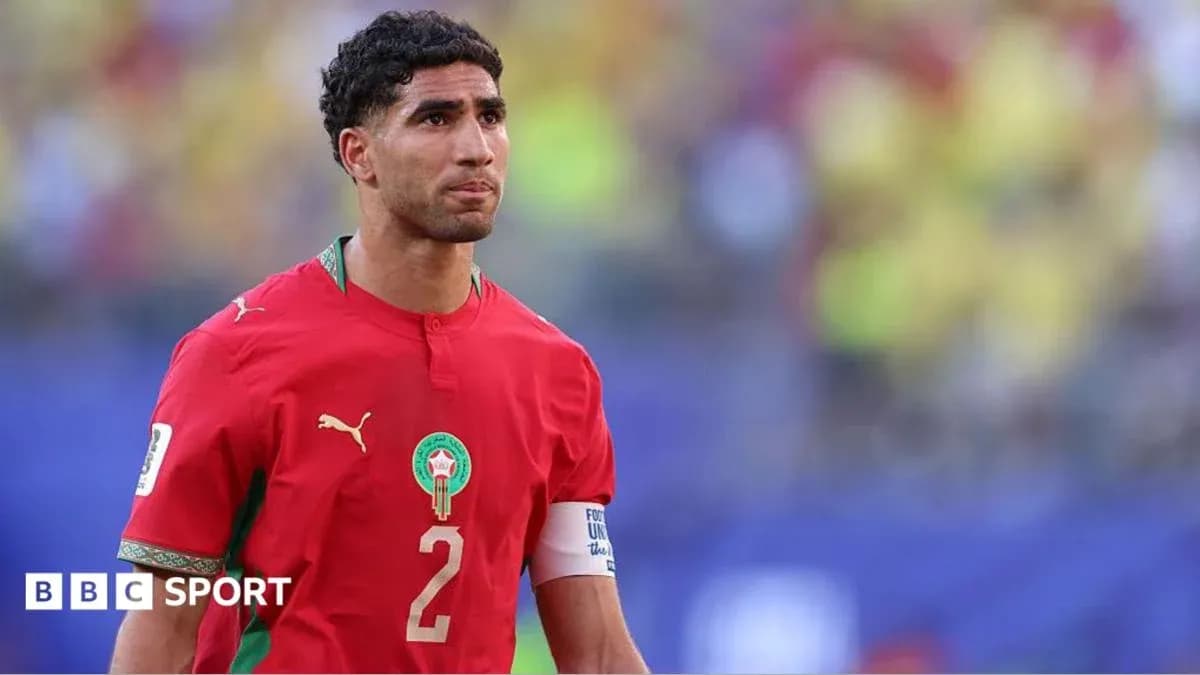
Achraf Hakimi Faces Rape Trial Amid World Cup Campaign
Achraf Hakimi, captain of Morocco and one of the most recognisable full-backs in world football, has been ordered to stand trial for rape in France, casting a stark shadow over his World Cup campaign.
French prosecutors in Nanterre confirmed that a trial has been mandated following a preliminary investigation that began in March 2023, after a 24-year-old woman accused the Paris St-Germain defender of raping her at his home in the Paris region that same year. An investigating judge ruled in February 2026 that the case should go to trial, and French media report that Hakimi, 27, has recently failed in an appeal to have the proceedings dismissed.
No trial date has yet been set.
A captain under scrutiny
Hakimi is set to lead Morocco out for their second World Cup fixture against Scotland on Friday (23:00 BST), but his preparations now run alongside a legal battle that has followed him for more than three years.
Throughout, he has consistently denied the accusations. On Friday, he broke his silence in a lengthy post on social media, offering a rare glimpse into his mindset as the case moves towards open court.
"The justice system looked me in the eye and said, 'If you weren't famous, there would never have been a case,'" Hakimi wrote.
"I chose to remain silent for years. I believed that maintaining my dignity, being patient, and trusting in the justice system would allow the right decisions to be made.
"Today, a story that isn't mine is being told at the expense of my family, my life, and above all, the truth. I sometimes feel like I've become an easy target.
"I've been waiting for this trial since day one. And now I'm eagerly awaiting it. Finally, I'll be able to speak."
Those words land in the middle of a World Cup cycle where Hakimi is not just another player, but the face of a generation. Ninety-seven caps, a debut at 17, and a starring role in the Morocco side that stormed to the semi-finals in 2022, the first African nation ever to do so. His trajectory has been relentlessly upward on the pitch, from Inter Milan to Paris St-Germain, where he has collected 13 trophies, including back-to-back Champions League titles in the last two seasons.
Off the pitch, the story is far more contested.
The accuser’s camp: ‘Relief and hope’
While Hakimi talks of finally being able to speak, the plaintiff’s side sees the decision to send the case to trial as long-awaited validation.
Rachel-Flore Pardo, lawyer for the woman who has accused Hakimi, welcomed the ruling in a statement.
"After more than three years of legal proceedings, and after my client was, in her view, defamed and dragged through the mud by Achraf Hakimi's defence, this decision brings her relief and hope.
"Relief that she has been heard by the justice system and will have the right to a trial.
"Hope that this trial will help other women and further weaken the wall of denial and impunity surrounding sexual violence, including in the world of men's football."
Her words frame the case as part of a broader struggle over accountability and power in elite sport, where accusations of sexual violence have increasingly intersected with major tournaments and star players.
World Cup complications
For now, Morocco’s focus remains on the group stage, all of which is being played in the United States, where the squad is currently based. On the pitch, Hakimi remains central to their plans. Off it, the legal cloud lingers — and could yet have practical consequences later in the tournament.
If Morocco progress to the knockout rounds, they may have to leave US soil. From the quarter-finals, the World Cup is staged exclusively in the United States, but before that, fixtures are spread across all three co-hosts: the US, Canada and Mexico.
That creates a new layer of uncertainty. With a rape trial ordered in France, Hakimi could face difficulties entering Canada or Mexico if Morocco are scheduled to play there. Canada’s government guidance is clear: entry can be denied to any person who has "committed or been convicted of a crime". How that is interpreted in cases where a player is charged but not convicted already looms large over this tournament.
The issue is not theoretical. Last week, Ghana midfielder Thomas Partey missed his country’s opener against Panama after being denied entry to Canada. Partey, 32, has pleaded not guilty to seven charges of rape and one count of sexual assault, relating to allegations by four different women between 2020 and 2022. He is due to stand trial next year.
Hakimi’s case is at a different stage, but the precedent is there. For national teams, logistics are becoming as complex as tactics.
Football, fame and a looming courtroom
Hakimi’s situation sits at the uneasy intersection of celebrity, justice and a global tournament that sells itself on spectacle and unity.
On one side stands a player who has become a symbol of Moroccan pride, a defender whose surging runs and set-piece precision helped carry his country to an unprecedented World Cup semi-final two years ago. On the other stands a woman who says she has spent years fighting to be heard, and a legal system that has now decided the allegations must be tested in open court.
The World Cup will move on in real time: kick-offs, group permutations, knockout drama. Hakimi will try to anchor Morocco’s back line and drive them forward, just as he always has. But somewhere in the background, away from the stadium noise, a French courtroom waits.
When the whistle eventually blows on his World Cup, his next defining contest may not be on grass, but under oath.