.svg&w=384&q=75 "naujapitch logo")
Villarreal vs Sevilla: Tactical Analysis of 2-3 Defeat
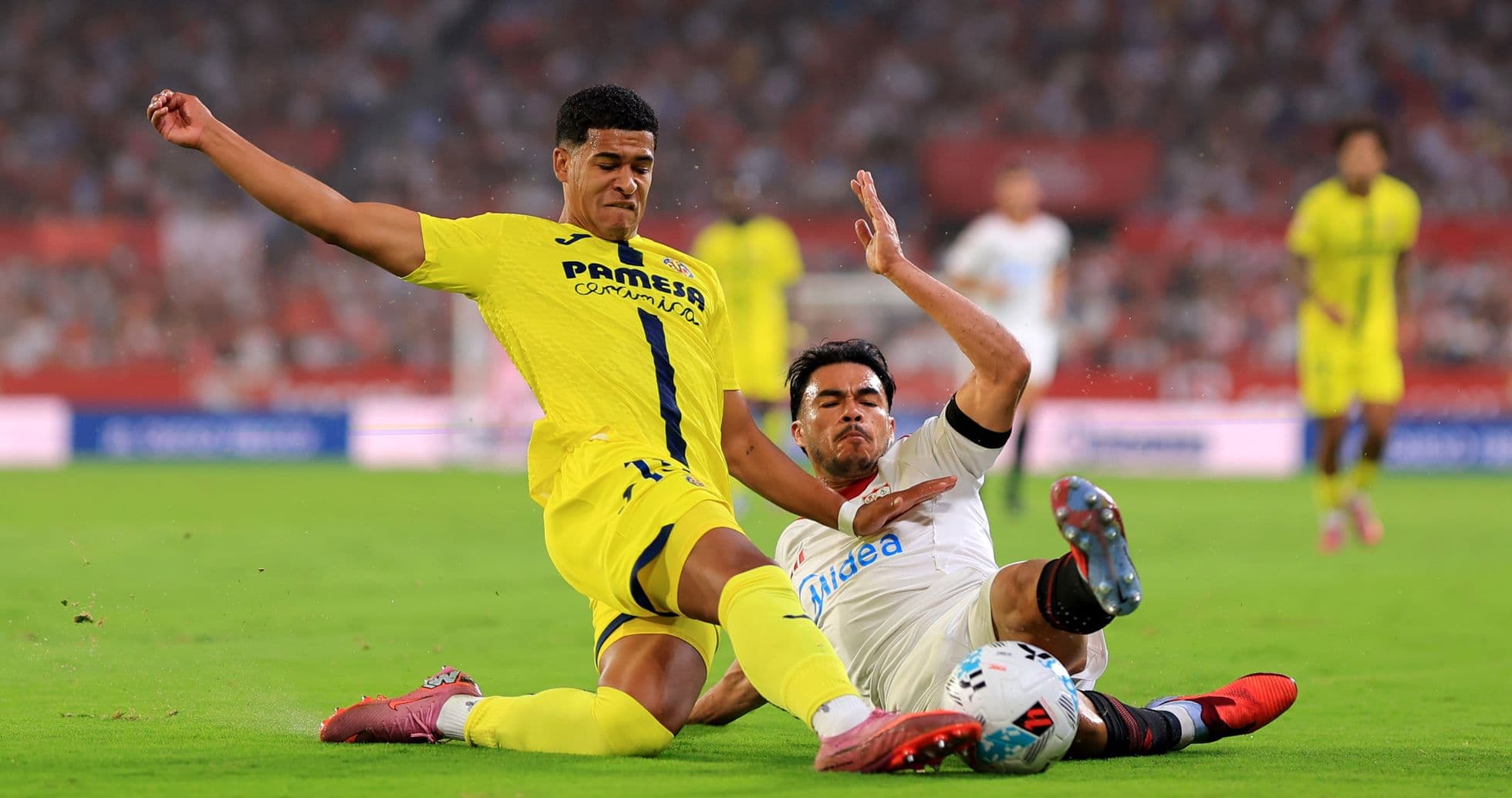
Villarreal’s 2-3 home defeat to Sevilla at Estadio de la Ceramica unfolded as a tactical swing rather than a pure contest of volume. The hosts dominated the ball and passing metrics but were gradually outmanoeuvred by Sevilla’s structural adjustments and superior penalty-box presence. In a La Liga match from Round 36 that was 2-2 by half-time and decided by a single second-half strike, the key story was how a 4-4-2 with 63% possession was dismantled by a compact 5-3-2 that grew into the game without ever needing territorial control.
I. Executive Summary
Villarreal, under Marcelino, set up in a 4-4-2 and started explosively, racing into a 2-0 lead through Gerard Moreno and Georges Mikautadze. Sevilla, coached by Luis Garcia Plaza and aligned in a 5-3-2, initially suffered under the home side’s circulation but recovered through set structure and vertical transitions, equalising before the break via Oso and Kike Salas. The second half belonged to Sevilla’s adaptability: a sharper mid-block, better use of the wing-backs, and a decisive attacking pattern finished by Andre Adams gave them a 3-2 win despite only 37% possession and fewer passes.
II. Scoring Sequence & Disciplinary Log
The goals and cards unfolded as follows:
Goals
- 13' Gerard Moreno (Villarreal) — assisted by Georges Mikautadze
- 20' Georges Mikautadze (Villarreal) — assisted by Alberto Moleiro
- 36' Oso (Sevilla) — assisted by Lucien Agoume
- 45' Kike Salas (Sevilla) — assisted by Rodrigo Vargas
- 72' Andre Adams (Sevilla) — assisted by Djibril Sow
Cards
- 81' Ayoze Pérez (Villarreal) — Foul
- 90+2' Renato Veiga (Villarreal) — Foul
- 90+3' José Ángel Carmona (Sevilla) — Time wasting
Total cards: Villarreal 2, Sevilla 1, overall 3.
The first phase was Villarreal’s: at 13', Moreno’s opener, created by Mikautadze, came from the front pair exploiting Sevilla’s back five before it could settle. Seven minutes later, the pattern repeated with roles inverted: Mikautadze finished from Moleiro’s supply, turning Sevilla’s wing-back corridor into a liability as Villarreal’s wide midfielders and forwards attacked the channels.
Sevilla’s response was methodical rather than frantic. At 36', Oso’s goal, assisted by Agoume, reflected Sevilla’s growing ability to play through their midfield three and find the overlapping defender from the back five. Just before half-time, at 45', Salas completed the comeback to 2-2, meeting a Vargas delivery that highlighted Villarreal’s fragility on crosses against Sevilla’s numerically superior back line pushing forward.
The decisive moment arrived on 72'. With Villarreal already having made attacking substitutions, Sevilla struck through Adams, assisted by Sow. The 5-3-2 morphed into a more aggressive transition shape, Sow breaking lines from midfield and Adams attacking the spaces behind Villarreal’s advanced full-backs to make it 2-3.
In the closing stages, Villarreal’s frustration surfaced. Ayoze Pérez was booked at 81' for Foul, followed by Renato Veiga at 90+2' also for Foul as Villarreal chased the game and committed late challenges. Sevilla’s game management was underlined at 90+3' when José Ángel Carmona received a yellow card for Time wasting, reflecting a deliberate effort to slow tempo and protect the lead.
III. Tactical Breakdown & Personnel
Marcelino’s 4-4-2 was built around control and vertical precision. Villarreal completed 554 passes, 499 accurate (90%), leveraging a wide midfield of Nicolas Pepe and Moleiro to feed the strike pair. The early 2-0 lead was a direct product of this: Villarreal circulated through Dani Parejo and Pape Gueye to draw Sevilla’s midfield three narrow, then hit diagonals into the half-spaces for Moreno and Mikautadze.
However, the same structure left them vulnerable. Full-backs Alfonso Pedraza and A. Freeman pushed high to pin Sevilla’s wing-backs, which initially worked but later exposed the centre-backs Pau Navarro and Renato Veiga to wide overloads. Sevilla’s 5-3-2, with Oso and Carmona as advanced wide defenders, began to exploit these gaps. Oso’s goal was emblematic: stepping from the back five into a pseudo-winger role, he arrived untracked from deep.
Luis Garcia Plaza’s 5-3-2 prioritised compactness over pressing. With only 325 passes, 276 accurate (85%), Sevilla rarely looked to dominate the ball. Instead, they relied on a narrow block with Agoume and Sow screening central lanes, inviting Villarreal wide and then springing transitions through Rodrigo Vargas and the front pair Adams and Neal Maupay. As the game progressed, Sevilla’s wing-backs and wide centre-backs pushed higher, turning the back five into a situational three when in possession.
The substitution vector shifted the game’s balance. On 60', Thomas Partey (IN) came on for Pape Gueye (OUT), adding more direct progression but sacrificing some early-game stability. Simultaneously, Tajon Buchanan (IN) came on for Nicolas Pepe (OUT), increasing dribbling threat but further stretching Villarreal’s shape. At 70', S. Comesana (IN) replaced Parejo (OUT), and Ayoze Pérez (IN) came on for Mikautadze (OUT), signalling a tilt towards attacking risk over midfield control. The net effect: Villarreal gained fresh legs in the final third but lost their best tempo-setter and a key reference for back-to-goal play.
Sevilla’s changes were more structurally coherent. At 68', J. Sanchez (IN) came on for Vargas (OUT), adding defensive energy in midfield. On 72', as Adams scored, the earlier substitution of Alexis Sanchez (IN) for Maupay (OUT) at 72' gave a different profile up front: more movement into channels and better hold-up to relieve pressure. Later, Nemanja Gudelj (IN) replaced Sow (OUT) at 86', and Castrin (IN) came on for Adams (OUT) at 86', consolidating the block to protect the 3-2 scoreline with added aerial presence and defensive discipline.
Goalkeeper reality underpinned both defensive stories. For Villarreal, A. Tenas made 2 saves but posted goals prevented of -0.22 against Sevilla’s xG of 0.88, indicating he conceded slightly more than an average keeper might from those chances. His back line allowed 13 shots (7 inside the box), meaning the problem was as much about volume and quality of looks as it was about shot-stopping. For Sevilla, Odisseas Vlachodimos faced only 6 shots, 4 on target, and made 1 save, with goals prevented also at -0.22 against Villarreal’s xG of 0.81. He was beaten twice early but then protected by a block that reduced the clarity of Villarreal’s chances after the break.
IV. The Statistical Verdict
The numbers frame this as a control-versus-efficiency contest. Villarreal’s 63% possession and 554 passes to Sevilla’s 325 suggest territorial dominance, yet the xG story was almost level: 0.81 for Villarreal, 0.88 for Sevilla. Sevilla generated more shots (13 to 6) and more efforts inside the box (7 to 4), reflecting better shot selection and a game plan oriented around fewer but more dangerous attacks.
Defensively, Villarreal’s overall form with the ball was strong, but their defensive index in this match was undermined by structural exposure: only 2 goalkeeper saves against 3 conceded, plus two late yellow cards for Foul as they chased. Sevilla, with just 9 Fouls and a single yellow for Time wasting, maintained composure and game management. The card totals — Villarreal 2, Sevilla 1 — reinforce the picture of a home side increasingly reactive and an away team comfortable in suffering.
Ultimately, the 2-3 scoreline, with Sevilla overturning a 2-0 deficit, is tactically consistent with the data: Villarreal’s possession-heavy 4-4-2 lost control of space, while Sevilla’s adaptable 5-3-2 converted limited ball into decisive, high-quality moments.