.svg&w=384&q=75 "naujapitch logo")
Sweden's Journey to the World Cup: From Chaos to Potter's Calm
Sweden’s wild road back to the World Cup: from chaos to Potter’s calm
The plan – or what passed for one
For a while, Sweden looked finished. One point from the first four qualifiers under Jon Dahl Tomasson, a 1-0 defeat away to Kosovo, and the sense of a team drifting without an identity. By October 2025, the Danish coach was gone and so, it seemed, were Sweden’s chances of reaching North America.
Then Graham Potter walked back into Swedish football.
The Englishman, who built his reputation in the frozen outpost of Östersund between 2011 and 2017, returned to a country that still viewed him as one of its own. Back then he had taken a fourth-tier club to the Allsvenskan, won the cup and outfoxed Arsenal in Europe. This time the stakes were higher and the margin for error almost non-existent.
Potter didn’t come promising revolution. He reached for something older, more familiar: the hard-edged Sweden of tournament lore. Compact lines. A defence that refuses to budge. Counterattacks that arrive like a punch you don’t see coming.
He had spoken publicly about preferring a back four. When it mattered, in the playoffs, he shelved that and went with a 5-3-2, locking down his back line and asking his forwards to live off transitions. Pragmatic, even conservative on paper. On the pitch, it brought clarity to a team that had been stumbling in fog.
The Nations League threw Sweden a lifeline back into the World Cup qualifying picture. They grabbed it with both hands.
In Spain, in the semi-final against Ukraine, the plan finally roared into life. Viktor Gyökeres produced a hat-trick that felt like a personal manifesto: power, movement, ruthless finishing. Sweden won 3-1 and suddenly the campaign had a heartbeat.
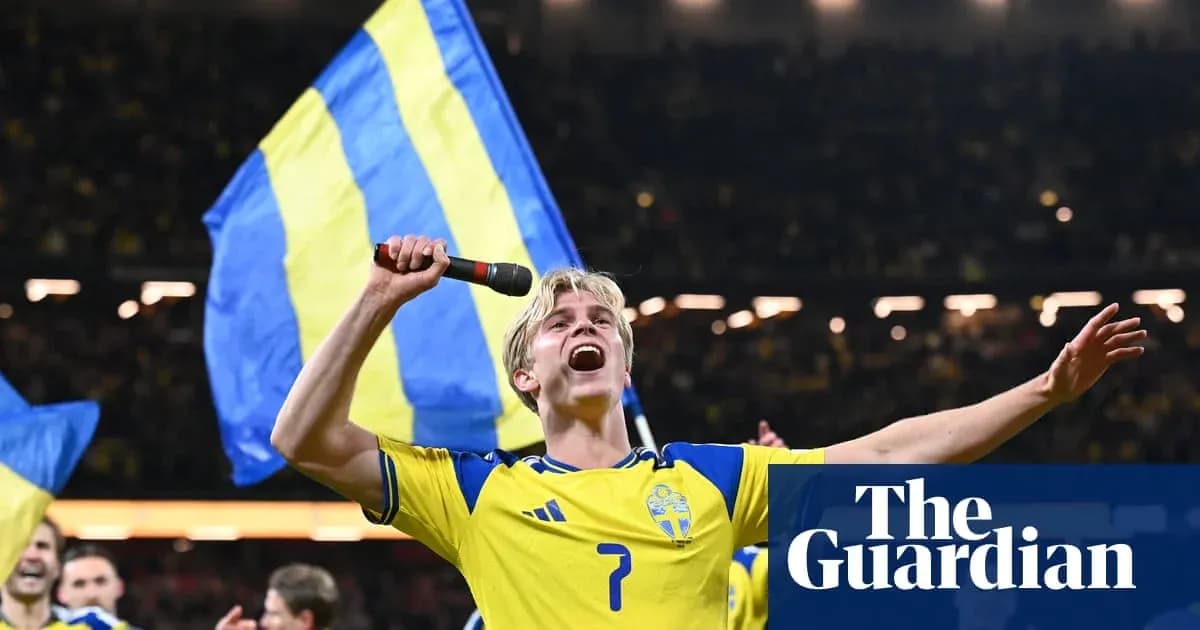
The final against Poland was different. Nervier. Poland controlled long stretches, asked constant questions, and for much of the night Sweden clung on. But the game stayed alive, and so did Gyökeres. In the 88th minute, with the tie on a knife-edge, he struck again to seal a 3-2 win. A playoff path that had begun as an act of rescue ended as a full-blooded revival.
Potter, usually measured, almost lost for words, called it the best night of his football life. Watching his bench stream onto the pitch as Gyökeres wheeled away, he spoke of an out-of-body experience. Sweden, somehow, were going to the World Cup despite taking just two points from their original six group games.
Now they land in a group with Tunisia, Netherlands and Japan, and the mood has flipped from resignation to possibility. That’s the Potter effect: not a promise of miracles, but a sense that this team once again knows who it is.
A big hole where the captain should be
The optimism comes with a brutal caveat. Dejan Kulusevski will not be there. The captain’s absence hangs over everything Sweden plan to do this summer. His influence – on the ball, in the dressing room, in the way this side carries itself – is enormous. You don’t replace that with a tweak to the shape.
Then there is Alexander Isak. On paper, the superstar. In reality, a riddle. Last year he became the most expensive signing in Premier League history, swapping Newcastle for Liverpool for £125m. The move has yet to fully ignite and his form and fitness have been under constant scrutiny. He did score after coming off the bench in a sobering 3-1 defeat to Norway on 1 June, but that game underlined as many worries as it eased.
For Sweden, though, the true talisman now wears Arsenal red.
Gyökeres, the Bane celebration and a new hero
This is Viktor Gyökeres’ team. The Arsenal forward also took time to find his feet at his new club, yet arrives at the World Cup as the man who dragged Sweden to it. Four of Sweden’s six goals across the two playoff ties were his. His late winner against Poland turned him from important to iconic.
The country responded in kind. Social media filled with fans imitating his celebration – a nod to Bane, Tom Hardy’s masked villain in The Dark Knight Rises. It’s theatrical, a little menacing, and entirely fitting for a striker who now looks capable of bending games to his will.
With Kulusevski out and Isak still searching for his best version, Gyökeres is no longer just an option. He is the reference point, the one Sweden cannot afford to lose.
Lagerbielke, the baron at the back
If Gyökeres supplied the fireworks, Gustaf Lagerbielke brought the steel.
The Braga centre-back delivered a defining performance in the playoff final against Poland. At one end, he thundered in a crucial header. At the other, he helped smother Robert Lewandowski, a task that has broken far more established defences than Sweden’s.
His story adds an extra layer of intrigue. A former Celtic defender, Lagerbielke is also a baron and, remarkably, 254th in line to the Swedish throne. It sounds like trivia until you watch the way he carries himself: calm, unflustered, a defender who looks at home in the chaos of a playoff final.
Talk of a move to one of Europe’s big-five leagues has already begun. A strong World Cup showing in North America would move those conversations from rumour to inevitability.
Karlström, the quiet anchor
Every tournament team needs its noise, but also its silence. Jesper Karlström provides the latter.
The Udinese captain is a late bloomer, a midfielder who had to scrap for every step. He needed time to establish himself at Djurgården, then left for Lech Poznan in Poland, where his game hardened and matured. Off the pitch, he has spoken openly about his struggles with a gambling addiction during his Djurgården days, and how the club and his family pulled him back.
On the field he is everything a deep-lying midfielder should be: firm in the tackle, sharp in his positioning, calm enough to dictate tempo when the game starts to race. At 30, he becomes the grown-up in a midfield that will likely feature younger talents such as Yasin Ayari and Lucas Bergvall.
Against a technically slick Netherlands and a tireless, intricate Japan, Karlström’s ability to win duels and then keep the ball will be critical. If Sweden are to survive the group, his work may define the tone of their tournament.
Potter, Sweden and a second chance
When Potter spoke to Fotbollskanalen in October 2025, it barely sounded like a hint. It was a plea.
“I have feelings for Sweden,” he said. “I love the country and I love Swedish football. Coaching the national team would be an incredible opportunity for me, absolutely.” Days later, he had the job. After bruising spells at Chelsea and West Ham, this felt like a return to somewhere that understood him – and where he understood the culture.
He speaks Swedish, knows the rhythms of the domestic game and, crucially, carries the trust of a federation that moved quickly to lock him in. By March, even before the playoff heroics were complete, the Swedish FA had extended his contract to 2030. They see him as a long-term architect, not a short-term firefighter.
His Sweden side is not glamorous. It is, however, coherent. And that alone marks a sharp break from the chaos that opened this campaign.
The fans and the travelling circus
Sweden rarely travel light. Blågult supporters traditionally arrive at tournaments in great numbers, turning host cities yellow and blue and filling squares with songs, jokes and an easy-going kind of mischief.
Their anthem of choice is “Kanna på”, a boisterous ode to beer pitchers that never stop arriving. It comes with a line that feels particularly apt before a World Cup in North America: “We are coming with 100,000 men.” That figure is poetic rather than literal, but the sentiment holds. Expect a sizeable Swedish presence, noisy but largely friendly, ready to share songs with whoever stands nearby.
The relationship with the United States has had its stranger moments. In 2017, Donald Trump told a rally: “Look what happened in Sweden last night,” while talking about immigration and terrorism. Nothing of note had happened. He later said he was referring to a Fox News report, which did little to clear the fog.
Swedish daily Aftonbladet responded by listing the actual events of that day: Owe Thörnqvist, a famous singer, had technical problems in rehearsals. A man set himself on fire in a central Stockholm plaza. Roads in northern Sweden closed because of harsh weather. That was it. No terror, no crisis, just the odd, mundane chaos of everyday life.
Now Sweden arrive on American soil with a different kind of story to tell. A team dragged from the brink, a coach rebuilding his reputation in a country he calls home from home, a striker wearing a comic-book villain’s mask as he shoulders a nation’s hopes.
They have already survived their own crisis. The question is whether that journey has merely earned them a ticket to the party, or something far more dangerous: genuine belief.