.svg&w=384&q=75 "naujapitch logo")
Liverpool's Broken Season: Anfield Sings Bob Marley as Change Looms
They sang to convince themselves as much as anyone else. “Every little thing is gonna be alright,” rolled around Anfield, Bob Marley echoing off the old stands while the evidence on the pitch screamed the opposite.
Liverpool’s 1-1 draw with Brentford closed the book on a season that ended with Champions League qualification but felt like something far closer to collapse. The numbers are brutal. Sixty points. Fifth place. Seventeen league wins. Their lowest win percentage in a decade. By any measure Liverpool set for themselves over the last nine years, this was a failure.
And it felt like a farewell.
End of an Era, and the Souness Shadow
Two pillars of the most successful Liverpool side of the modern era have already gone. More will follow. Mo Salah and Andy Robertson are heading for the exit, and half the squad Arne Slot inherited just two years ago has already been dismantled. A handful more are expected to leave.
For Kopites of a certain age, the parallels are hard to ignore. Graeme Souness once tore through Kenny Dalglish’s ageing but title-winning squad, ripping out the old guard in the name of renewal. He was sacked. What followed was a long, grey stretch of mediocrity.
That spectre hangs over this summer. Salah, as the curtain dropped on his nine extraordinary years, made no attempt to hide his concern about the club’s direction. On the pitch, Liverpool limped to the line: one win in their final four league games, four in their last 14 in all competitions. This was not a team on the rise. This was a team clinging on.
The bare facts sting.
- Sixty points would have left them ninth last season.
- Seventh the year before.
- Ninth again three seasons back.
Sixty points is the lowest total to bring Champions League football since 2003/04, the season Gerard Houllier’s reign ended with a polite handshake and a photoshoot on the Anfield turf. That was framed as a “mutual” parting. This feels more like a warning.
Slot on the Bench, Salah in the Storm
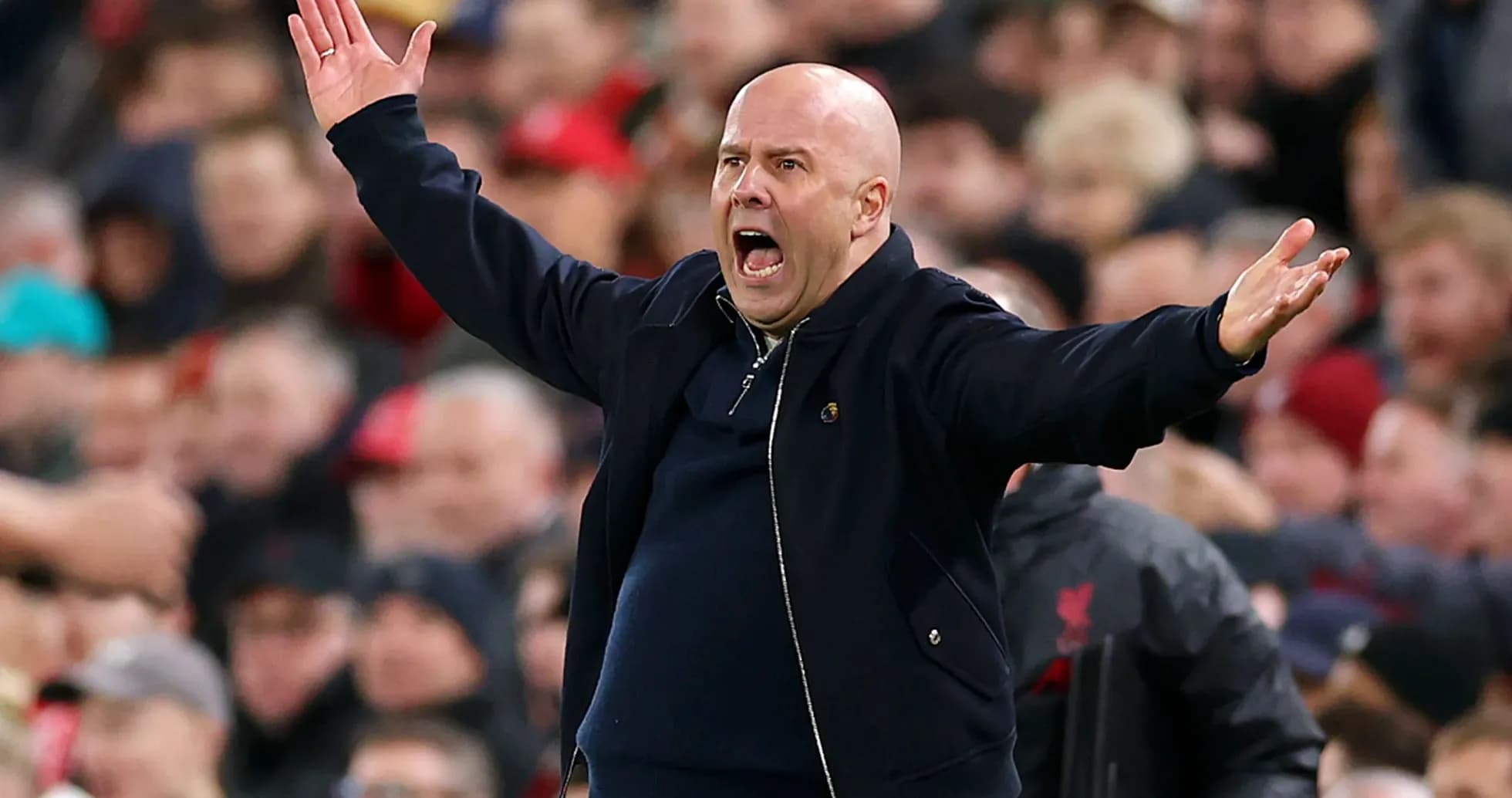
Slot insists he can win the supporters back next season. He will need to. As fans filtered out of Anfield after Brentford, much of the talk wasn’t about the point, or even the departures, but about the head coach’s posture in the aftermath.
While the squad walked the traditional lap of appreciation, Slot stayed seated on the bench, arms folded, expression fixed. Maybe he was simply drained, lost in thought. It didn’t look malicious. But it looked wrong.
The lap is ritual at Liverpool. Players and staff salute the fans; the fans respond in kind. It’s a moment of shared ownership of the season, however it has gone. Slot stayed apart. On a day when supporters had endured the lowest win percentage in ten years, their coach sat alone, missing a simple chance to connect.
Salah did not miss his. “They [the fans] don’t care that much about the result as long as you sweat and give your blood here, they’ll love you forever,” he told Sky Sports.
That line cuts to the heart of the club. Liverpool supporters will tolerate setbacks. They will not tolerate a sense that standards are softening or that the people in charge don’t quite get it. “Walk on through the storm” is not just a lyric; it’s a demand to do it together. This season, too often, it felt like the players and staff were walking in different directions.
Injuries, a Small Squad, and a Big Contradiction
In his final press conference of the campaign, Slot was asked to sum up Liverpool’s season in one word. “Injury,” he replied.
On one level, he’s right. The squad was ravaged. Players struggled with the rhythm of midweek and weekend football. Late goals were conceded, line-ups were patched together, and the sense of physical and mental fatigue never really lifted.
But Slot’s own words from October linger in the background. “This is a decision we have made together,” he said then, speaking about the size of his group. “I completely believe in this, because if you have 25 [players] it’s very hard to manage your squad.”
You cannot embrace a small squad in autumn, then spend winter and spring lamenting the lack of bodies. The Premier League is relentless, the Champions League is expanding, and Liverpool went into the season knowing some of their new signings could not handle 90 minutes twice a week. So why go short?
“I like my squad so much,” Slot said back then. “But we don’t have 25 or 26 [players], so if we end up with two, three or four injuries, 15 or 16 players, where Rio and Trey are two of these 15 or 16, then need to play almost all the minutes and then things can become complicated.”
In reality, those fringe names barely played. Trey Nyoni, handed his debut by Jurgen Klopp at 16 and widely viewed as one of the brightest talents at the club, finished the league season with just 21 minutes. Federico Chiesa, marginalised yet again, logged only 318 league minutes. Wataru Endo, signed to bring nous and stability, played 170.
Kieran Morrison, captain and player of the season for the Under-21s, was named on the bench 13 times. He was used once, for five minutes in an FA Cup tie at Wolves.
So the squad was not just small; it was smaller than it needed to be by choice. Slot talked about trusting his group, but his team sheets told a different story. Then came the Harvey Elliott fiasco: no agreement in place to bring him back to Anfield in January, just as the first team were crying out for quality from the bench. Liverpool stumbled through the second half of the season short of exactly the kind of player they had allowed to stay away.
Heavy Defeats and Heavy Standards
Slot has tried to frame the cup exits as understandable collateral. Liverpool went out of the FA Cup 4-0 to eventual winners Manchester City, and fell 4-0 on aggregate to PSG, who have not lost a two-legged European tie in two seasons.
Those are elite opponents. The scorelines still jar.
Liverpool’s senior figures haven’t sugar-coated it. Virgil van Dijk, Robertson, Salah and Curtis Jones have all spoken of standards not being met. Salah’s final message to his team-mates at the AXA Training Centre was blunt: “Being in Liverpool, winning something for Liverpool and winning games is the best thing that could happen to you all.”
Slot, for his part, described Champions League qualification as “our lowest base,” before pointing out that “big clubs” such as Chelsea and Tottenham had missed out on Europe entirely. That line will not land well on the Kop. Liverpool do not measure themselves against the failures of others. They measure themselves against their own history.
At this club, exiting competitions to the eventual winners is not a comfort. Losing 4-0 in the process, during a run of four defeats in five games, is a stain.
Even Liverpool’s longest unbeaten run this season, 13 games after a 4-1 home humiliation by PSV, carried more questions than answers. Buried within it were draws with Leeds (twice), Burnley and Fulham, and seven wins that included Barnsley in the FA Cup and a West Ham side that would end up relegated. The streak looked impressive on paper. On the pitch, the cracks were obvious.
Transition, Uncertainty and a Thin Attack
Now comes another summer of “transition.” Slot says it will not be as “drastic” as last year, but the list of potential departures suggests otherwise.
His own contract has just one year left. So do those of the club’s key decision-makers, Richard Hughes and Michael Edwards. Their futures are no clearer than his.
On the pitch, as many as nine first-team players could go.
- Salah and Robertson are expected to depart.
- Ibrahima Konate is out of contract.
- Chiesa and Endo look expendable.
- Curtis Jones, wanted by Inter Milan and also down to his final year, is widely tipped to move on.
- Alisson is on Juventus’ radar.
- Joe Gomez has a year remaining and could be cashed in.
- Alexis Mac Allister, if the right offer arrives, is not considered untouchable.
Strip all that away and you’re left with a startling statistic: Liverpool will go into next season with Cody Gakpo as their leading goalscorer for the club. Virgil van Dijk, a centre-back, will be second on that list.
This is not the profile of a squad ready to chase titles. It is the profile of a squad that needs surgery in almost every department.
Slot insists he can rebuild without another upheaval. The evidence points to a summer where almost everything is up for discussion.
As the Kop sang about not worrying, the reality was written on faces and in conversations all around Anfield. They have lived through false dawns before. They know what it looks like when a great side tips over the edge.
The song said everything would be alright. The summer will decide whether anyone really believes it.