.svg&w=384&q=75 "naujapitch logo")
Hugo Broos Critiques Atlanta Stadium as Bafana Bafana Eye World Cup Progress
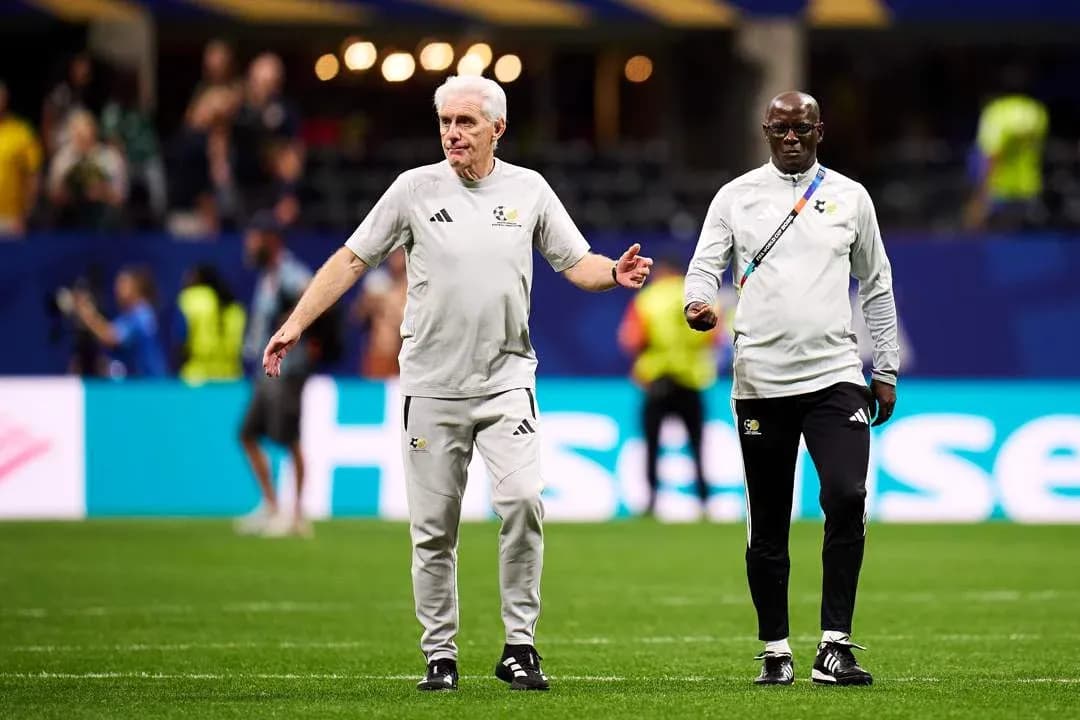
Hugo Broos walked out of Atlanta Stadium with a point, a pulse in South Africa’s World Cup campaign – and absolutely no love for the venue that hosted it.
His team had just dragged themselves back from the brink against Czechia, a late Teboho Mokoena penalty sealing a 1-1 draw that keeps Bafana Bafana alive in Group A. The performance stirred him. The setting did not.
“This is not a football stadium,” the 74-year-old said, cutting straight through the post-match pleasantries.
A fight under a closed roof
Under the closed roof and bright, polished glare of Atlanta’s multi-purpose arena – home to the Atlanta Falcons and Atlanta United – Bafana’s night started badly.
Czechia struck first. In the sixth minute, Michal Sadilek found the breakthrough, his early effort tilting the game towards the Europeans and threatening to drag South Africa back into familiar World Cup heartache.
Bafana wobbled, but they did not fall.
Broos’ side grew into the contest, pressing higher, asking questions, refusing to accept that the script had already been written. They chased, harried and kept faith that a chance would come.
It did. Seven minutes from time, the pressure finally told.
Pavel Sulc was penalised for handling inside the area, and suddenly the noise shifted. Mokoena stepped up, composed and cold, and rolled in the penalty to drag South Africa level. One kick, and a campaign that seemed to be slipping away jolted back into motion.
The draw breathed life into Group A for Bafana. It also lit a fire under their coach.
‘Only the grass is football’
Broos has seen enough stadiums in a long career to know what he likes. Atlanta’s gleaming bowl did not make the cut.
“It’s a nice stadium, fantastic stadium, everything you want. But only the grass is football. All the rest is not,” he said, drawing a sharp line between this closed-roof arena and the raw, open cauldron of the Estadio Azteca, where South Africa opened their World Cup with a 2-0 defeat to co-hosts Mexico.
“It’s a covered stadium. I like to play in an open stadium. I don’t feel really the atmosphere in such a stadium. When you compare it with Azteca, for example, that is a football stadium!”
For Broos, the game needs air, sky, noise that rises and falls naturally, not sound trapped under a roof.
“These stadiums are fantastic stadiums for the crowd. I think they see everything in that stadium. There are no places that are covered or whatever. But, again, I rather like a real football stadium.”
His issue was not with the spectacle for the fans. It was with the soul of the place. For a coach who craves edge and emotion, this felt more like a showpiece than a football battleground.
Rhythm broken by cooling breaks
The Belgian’s frustrations did not stop at the architecture.
Inside a climate-controlled arena, the match still paused for hydration breaks. For a man obsessed with momentum, it grated.
“I think it’s very, very useful when it’s hot,” Broos said. “But in other cases, the rhythm of the game is lost.
“When at that moment you are the best team and you dominate, suddenly your domination is blocked for five minutes or I don’t know how long... in that stadium, we don’t need to drink after 20 minutes.”
South Africa had spells where they pressed Czechia back, where their energy and aggression tilted the pitch. Each stoppage felt, to Broos, like a handbrake yanked at the worst possible time.
Still, his players found a way to reset, to push again, to claw back a result that keeps everything in play.
Destiny on the line against South Korea
The table now gives Bafana something they have rarely had at a World Cup: control over their own fate.
The draw means South Africa’s destiny sits firmly in their own hands heading into a decisive final Group A clash against South Korea. The Taegeuk Warriors arrive on the back of a narrow 1-0 defeat to Mexico, which turns Thursday’s meeting at Estadio Monterrey into a high-stakes test for both sides.
For Bafana, the stakes are clear. This is still a hunt for history.
In only their fourth appearance on this stage, they have never escaped the group phase. A win in their final outing would dramatically strengthen their chances of reaching the Round of 32, whether via a top-two finish or as one of the best third-placed teams. It would also mark a rare away victory at a World Cup for South Africa, a landmark result for a team trying to redefine its ceiling.
Broos believes the template is there.
“If we can make another performance like today, I think we have a chance to go in the second round,” he said. “I’m very proud of my team, and this is the real Bafana Bafana.”
The venue will change again on Thursday, from the Azteca’s myth to Monterrey’s intensity. The roof will be open, the air different, the noise raw.
The question now is simple: with their fate in their hands and their identity finally showing, can this “real Bafana Bafana” turn a defiant draw into a piece of World Cup history?