.svg&w=384&q=75 "naujapitch logo")
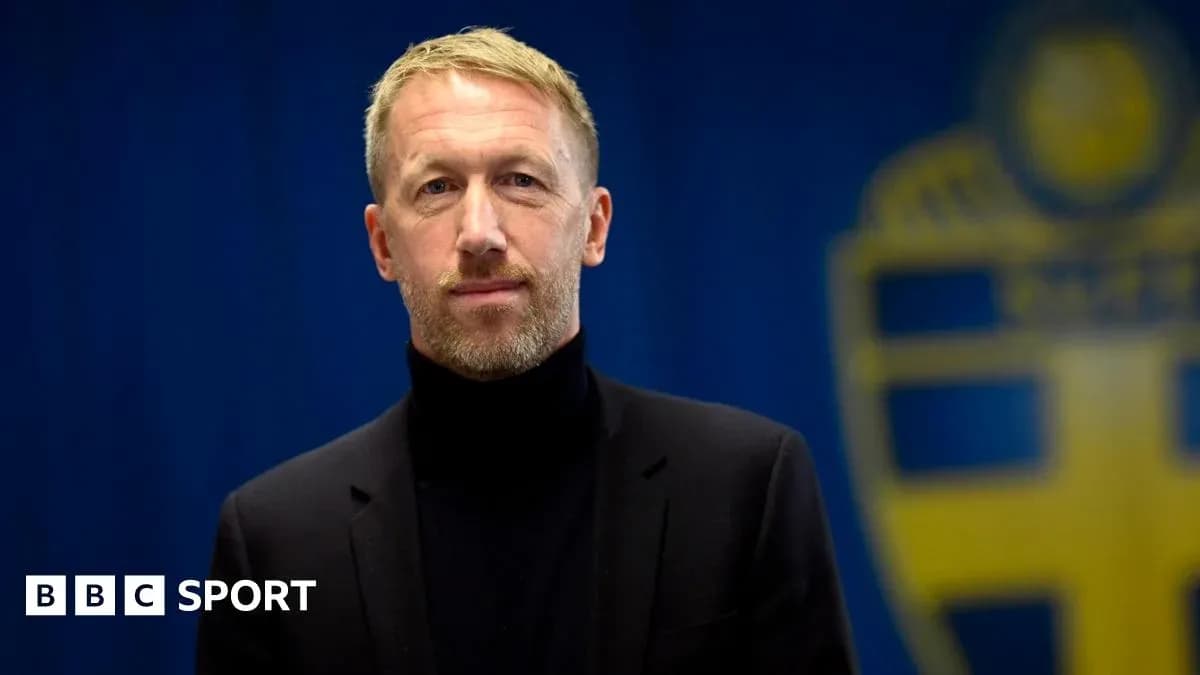
Graham Potter's Journey from Chelsea to World Cup Glory with Sweden
Graham Potter stood on the touchline in Stockholm and let the words fly, unfiltered and pure.
"We are going to the World Cup, baby."
An 88th-minute winner from Viktor Gyokeres had just torn through Poland and detonated inside Strawberry Arena. A 3-2 play-off victory, 50,000 people losing their voices, and a 51-year-old coach who has lived both glamour and humiliation suddenly finding himself at the centre of the kind of night managers spend careers chasing.
He called it "the best night of my career". Given where he has been, that line carries weight.
From Chelsea scars to Stockholm ecstasy
Potter does not pretend the last few years have been kind. Chelsea chewed him up inside seven months. West Ham lasted barely eight. Both ended in the cold, the second dismissal coming last September.
"It hurt. They are painful experiences," he admitted. No spin, no softening. Just the blunt reality of a manager who has felt the floor give way beneath him.
"I have lived failure. I've had quite a bit of success too. That's what life is," he said. Perspective has become his armour: listening only to those who matter, taking feedback from people "who can help you improve", and trying – somehow – to feel grateful for the bruises.
"When you're going through it, it isn't easy," he added. "You have to deal with the failure, but you become a better person for it, that's for sure."
Then came that night in Stockholm. Gyokeres, already fresh from a hat-trick against Ukraine in the previous game, drove in the late winner that sent Sweden to their first World Cup since 2018. The release was instant and feral.
"Viktor scores and it's like an out of body experience," Potter said. "All our subs are running on the pitch. There's 15 players on the pitch and I'm thinking, 'That's yellow cards, that's problems'. But of course it's a World Cup, so all the rules are out the door."
The final whistle only amplified it. "The feeling in the stadium was just incredible," he said. For a manager whose recent years have been defined by criticism and sackings, the surge of joy cut deep.
"It's so nice to have to experience positivity through football, because obviously recently I haven't had too much of that, so it's quite nice, of course, on a human level."
How did he celebrate? "What do you think I did?" he replied with a smile. A few drinks, some time to soak it all in – but no wild excess. He knows the pendulum swings both ways.
"You're never quite as good as you say when you're there [high], and you're never quite as bad as they say when you're there [low]. So, you've got to find some way of keeping some perspective."
The Englishman who became Swedish
If this all feels like a perfect fit, it is because Potter did not just arrive in Sweden as a star name parachuted in from abroad. He built his coaching life there.
Long before the Premier League, he took Ostersunds FK from the fourth tier to the Allsvenskan, winning the domestic cup and guiding them into Europe. Those seven years rewired him.
"I feel very Swedish when I'm working," he said. He even sings the national anthem before matches. He learned the language. Two of his children were born there. He jokes he even looks a bit Swedish now.
"I came from the fourth tier of Swedish football, which is quite low, and worked my way up through the system to the Allsvenskan," he said. "You almost become Swedish in a coaching sense because of the experiences you have. I think it has definitely helped.
"Now I'm working for the Swedish FA as head coach of the national team, so I feel very Swedish."
His new Instagram account shows a coach at ease in his surroundings – wandering through forests and lakes, reading Nordic literature, turning up at cultural events. This is not a tourist. It is someone who has embedded himself.
So when Sweden called in November, asking him to replace Jon Dahl Tomasson on an initial short-term deal, it was not a leap into the unknown. It was a calculated return.
He extended his contract to 2030 before the March international break, before qualification was sealed. He will now lead Sweden at this World Cup, and, if they make it, at Euro 2028 and the 2030 World Cup as well.
"Maybe in England we have taken it for granted because we usually qualify," he said. "But the reality is that many countries do not, so it is special when they do. It is also very important for the finances of the football structure."
The country has noticed. Even Zlatan Ibrahimovic reached out with a congratulatory message. Potter called him "one of the kings of Sweden". In a land where the 1994 World Cup still lives in the collective memory – bronze medals in the USA, Tomas Brolin and that famous song "När vi gräver guld i USA" – qualifying still stirs something deep.
Potter can even recall that song. For him, this World Cup is not just another tournament; it is a chance to step into a story he grew up admiring from the outside, then studied from within.
Isak, Gyokeres and a new Swedish edge
The decisions have not been easy. Some players have been left behind after those "toughest conversations as a father and human being". But the front line he can call upon is as dangerous as anything Sweden have fielded in a generation.
Alexander Isak, now at Liverpool after his record £125m move from Newcastle last summer, and Gyokeres, the Arsenal forward who has just fired his club to the Premier League title and a Champions League final with 21 league goals, will carry much of the attacking burden.
"I think they are different in their styles, which is good for us because you can hopefully use them effectively," Potter said. "The honest truth is that we haven't played them together yet in my time, so that will be exciting to develop. If we can get them enjoying their football and firing, they are top players."
Isak has had an injury-hit season and has yet to start a game under Potter. The step up to a superclub has brought its own strain.
"It can take a bit of time," Potter said. "At the biggest clubs there is pressure and expectation, and when expectation and reality begin to diverge, it can create problems.
"His injuries have been disappointing, but I know him well. He is a top professional who wants to play and help his team."
Gyokeres, by contrast, has barely stopped scoring since he arrived at Arsenal from Sporting for £55m. Twenty-one league goals, a title, a Champions League final – and still, criticism has found him.
"It is a good example of the modern game," Potter said. From where he is standing, the numbers speak clearly enough. "From our perspective, he has scored four goals in two matches and helped take us to the World Cup, so his impact has been significant."
Their stories intersect with Potter’s in another way. He remembers a teenage Isak, 16 years old, scoring on his professional debut for AIK. The opposition that day? Potter’s Ostersunds.
Now they reunite on the biggest stage, carrying a nation’s hopes into Group F, where Tunisia, the Netherlands and Japan await.
Humble base, huge stage
As one of the last teams to qualify, Sweden did not get first pick of World Cup training bases. They will be stationed at SDJA, a high school facility in San Diego. It is hardly a luxury compound, but Potter is not complaining.
He has highlighted the importance of set-pieces in the heat, the need to adapt, the value of detail when margins shrink. The environment, he insists, is good enough.
The real twist is in their preparation. While England head to Miami, Sweden will stay at home in Stockholm before the tournament. Players will be allowed to spend time with family and friends, to decompress after a draining club season.
After friendlies against Norway and Greece, they will board the plane and step back into a world Potter first fell in love with as a boy.
"My first football memory is from 1986 – I was 11, watching Diego Maradona," he recalled. That was the moment the game stopped being just a pastime and became something else entirely.
Now he walks into that arena as head coach of a nation that has, in many ways, become his own. On 15 June, against Tunisia, Graham Potter will stand on the touchline at a World Cup, leading Sweden out.
For a man who has lived failure, been sacked, rebuilt and then screamed "We are going to the World Cup, baby" into the Stockholm night, the next question is simple.
What does he do for an encore?