.svg&w=384&q=75 "naujapitch logo")
Fantasy Premier League Reclassifications: Key Players to Watch
The game inside the game has shifted again.
Fantasy Premier League’s reclassification committee has gone to work ahead of 2026/27, and a handful of emerging names now sit in new positions – with potentially huge consequences for how managers build their squads.
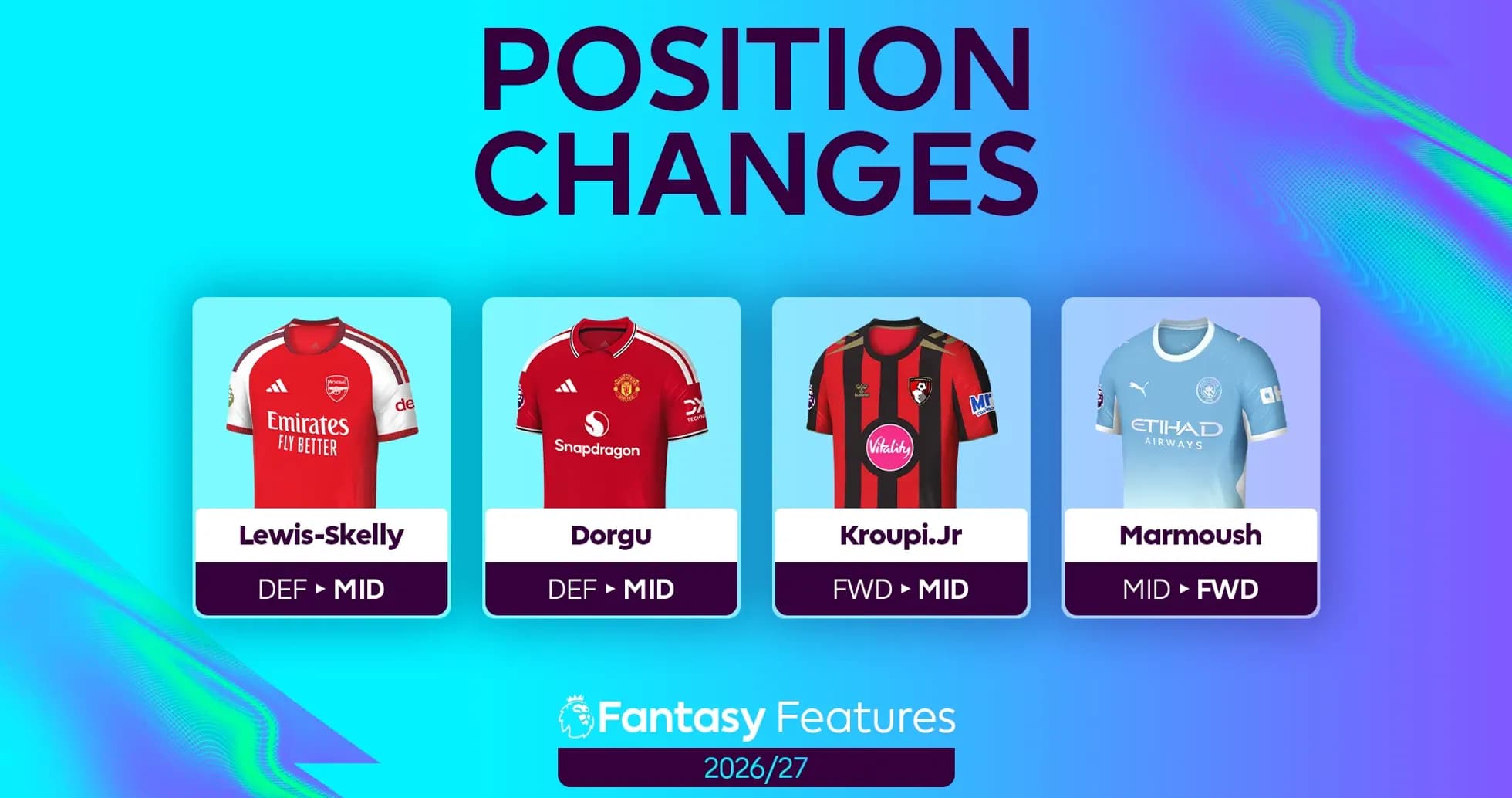
At the heart of it all: Junior Kroupi, Patrick Dorgu and Omar Marmoush.
Kroupi: From finisher to Fantasy gold mine
Bournemouth’s Junior Kroupi is the headline act. On paper, he moves from forward to midfielder. In reality, that change simply catches up with what everyone watched last season.
Kroupi spent his breakout campaign operating as a No 10, floating behind Evanilson, linking play and then bursting into scoring areas. The numbers were ruthless. Thirteen goals in 33 appearances, delivered from that central support role, turned him from a promising talent into a genuine FPL weapon.
His 134.0 minutes per goal underlines just how sharp he was. To put that into context, Antoine Semenyo – the quickest among regular midfield starters last season – averaged 188.2 minutes per goal. Kroupi was more than 50 minutes faster per strike.
Now the game has caught up. Listed as a midfielder, he will be rewarded with an extra point for every goal and will benefit from clean-sheet points as well. For Fantasy managers, that’s the perfect storm: a forward’s penalty-box threat packaged in a midfielder’s scoring matrix.
If Bournemouth’s attack continues to run through him in that central pocket, Kroupi doesn’t just become an option. He becomes a potential cornerstone.
Dorgu: Carrick’s winger gets a Fantasy promotion
At Manchester United, Patrick Dorgu’s reclassification tells a quieter story, but one with real intrigue.
Last season he started out as a defender. Under Michael Carrick, that label quickly became outdated. From Gameweek 22 onwards, when Carrick took charge, the Dane was used higher up the pitch, operating as a left winger whenever he made the XI.
He didn’t play much – just three starts in that spell – but he made every one of them count. A goal against Arsenal. Another against Manchester City. Then a goal and an assist versus Brighton & Hove Albion. Three starts, three games with a goal contribution, all from an advanced wide role.
Stack his output against his midfield competition at Old Trafford and the picture sharpens. When measured against Matheus Cunha and Bryan Mbeumo under Carrick, Dorgu posted the quickest shot frequency of the trio, firing off an effort every 33.2 minutes. He also matched Cunha’s tally of three big chances, despite logging over 800 minutes fewer than the Brazilian.
Now FPL has moved him where he actually plays: into midfield. The defensive classification is gone. The attacking numbers remain.
If Carrick leans into that left-wing role over a full season, Dorgu shifts from a curiosity on the team sheet to a live Fantasy differential, especially if he’s priced kindly after such a small sample.
Marmoush: Guardiola’s striker steps into the light
At Manchester City, the arrow points the other way.
Omar Marmoush, previously tucked into the game as a midfielder, is now correctly labelled as a forward after Pep Guardiola pushed him up front in his final season in charge.
Used through the middle, Marmoush produced three goals and three assists, a solid return in a side overflowing with attacking options. The role was clear: lead the line, stretch defences, and finish off the moves constructed by City’s creators.
That central striking berth now comes at a cost in FPL terms. As a forward, Marmoush loses the extra point for goals and the chance to profit from clean sheets. His appeal will hinge on two questions: how central he remains in City’s attacking plans under the new regime, and how competitively he’s priced against the established heavyweight forwards.
For managers, he shifts from being a potential value midfielder to a calculated gamble in a fiercely contested forward pool.
The other switches that could matter
Around those headline names, a cluster of quieter reclassifications could still shape the margins of a season.
At Arsenal, Myles Lewis-Skelly moves from defence into midfield, aligning his Fantasy role with his on-pitch usage and potentially opening the door to attacking returns if he earns minutes in a possession-dominant side.
Aston Villa’s Lamare Bogarde makes the same journey, defender to midfielder, while at Brentford, Keane Lewis-Potter goes the opposite way, now listed as a defender after previously being classed as a midfielder. If he continues to operate in advanced wide areas from a nominal full-back or wing-back slot, that defensive tag could prove crucial for managers hunting attacking returns from the back.
Brighton & Hove Albion see a double adjustment: Mats Wieffer drops from midfield into defence, hinting at a deeper or more structured role, while Georginio Rutter shifts from midfield to forward, underlining his use at the sharp end of the attack.
Crystal Palace’s Rio Cardines moves from midfield into defence, potentially offering another attacking full-back option if his role matches that new label. At Fulham, Ryan Sessegnon goes the other way, defender to midfielder, reflecting his long-standing identity as a wide attacker more than a traditional full-back.
Nottingham Forest’s Eric Moreira rounds off the list, reclassified from midfield to defence. If he nails down a starting berth in an advanced defensive role, he could slip onto Fantasy watchlists as a budget enabler.
These tweaks don’t grab the headlines like a blockbuster transfer or a double gameweek announcement. But they tilt the board.
Kroupi suddenly looks like a premium-style asset without a premium tag. Dorgu turns from defensive footnote into midfield wildcard. Marmoush steps into a more demanding Fantasy category just as City enter a new era.
For managers already sketching out their first drafts, the question is simple: who do you trust to turn a new label into a season-defining edge?