.svg&w=384&q=75 "naujapitch logo")
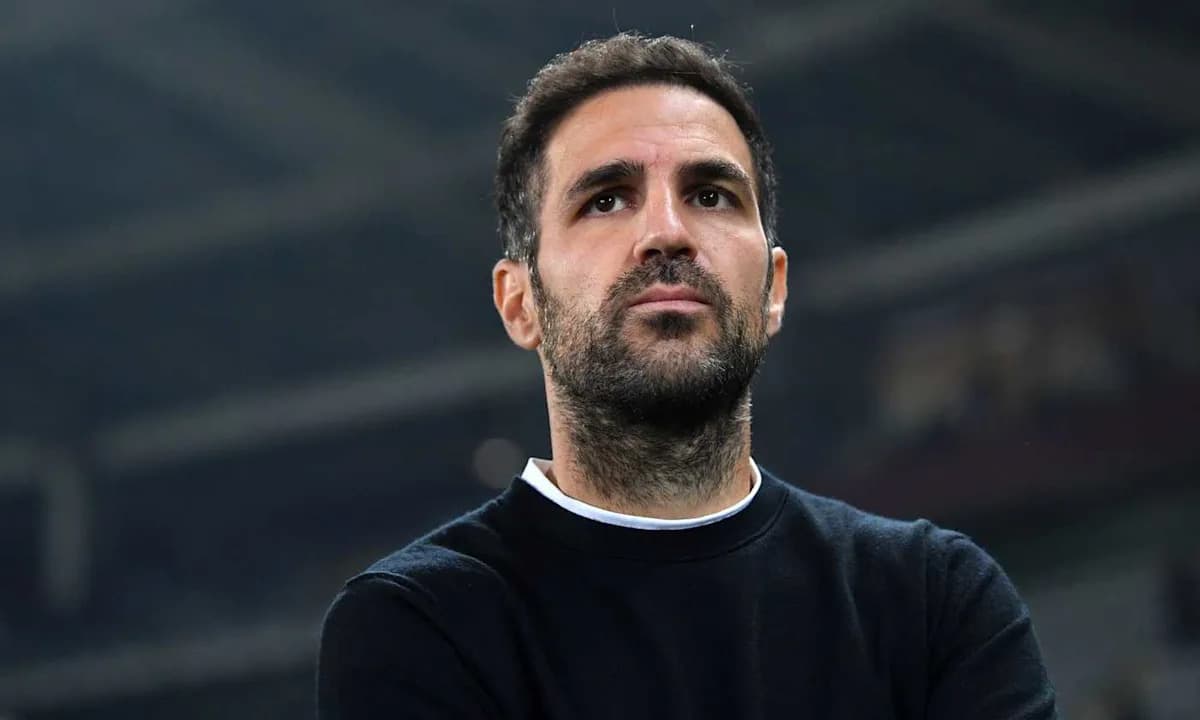
Cesc Fàbregas Considers Future at Real Madrid
Cesc Fàbregas does not slam doors. He leaves them ajar.
The Como coach, forged in La Masia and twice tied to Barcelona as a player, has not ruled out one of the most provocative ideas in modern Spanish football: one day sitting on the bench at Real Madrid.
For a man so closely associated with Barça’s identity, the notion sounds almost heretical. He did not flinch.
A Barça son who won’t rule out the Bernabéu
Fàbregas is in the middle of an eye-catching rise in Serie A. Como have just secured the first European qualification in the club’s history, a landmark that has quickly turned the spotlight onto the 37-year-old on the touchline rather than the playmaker he once was on the pitch.
His work has not gone unnoticed. Top clubs, including former side Chelsea and Real Madrid, have been linked with admiration for what he is building in northern Italy. Yet when he spoke to Cadena Cope, his message was clear: he is not packing his bags.
“I’m a shareholder in the club (Como), I saw a project to start coaching, I have a contract and I’m very relaxed… I’m in a place that helps me grow and I’m very happy. I’m the one who makes the signings.”
This is not a man treating Como as a stepping stone. He is invested, literally and emotionally. He shapes the squad, drives the project, and talks like someone who feels ownership of the future.
Still, the Real Madrid question hung in the air.
“I don’t have a red line,” he said. The only limit he draws is on his role. “One red line, and I’ve been very clear about this from the beginning, is that I wouldn’t want to be an assistant… for example. I’m clear that I want to be a head coach. The other thing (the possibility of Real Madrid)? I haven’t even thought about it or considered it. I haven’t had time for anything.”
No grand declarations of loyalty. No dramatic “never.” Just a coach who wants to lead, wherever he goes.
Admiring Luis Enrique, longing for Ancelotti
Asked which managers he looks up to, Fàbregas pointed first to Luis Enrique, praising the body of work the Spain coach has put together over the last two years. The respect is technical, but also ideological; Luis Enrique is a coach who imposes his ideas, who lives and dies by them.
Yet if there was one manager he wishes he could have played under, it is the man currently in charge at the Bernabéu: Carlo Ancelotti. Fàbregas highlighted the Italian’s human side, the quality that so many of Ancelotti’s former players talk about with almost reverence.
That detail matters. Fàbregas is not simply studying tactics from afar. He is watching how the greats manage egos, dress rooms and crisis. The admiration for Ancelotti’s human touch dovetails with his own vision of leadership.
And that vision came into sharp focus when the conversation turned to Vinícius Júnior.
“Nobody is above the team”: Fàbregas on Vinícius and Xabi Alonso
Real Madrid’s season has been dissected from every angle, and one flashpoint keeps returning: Vinícius Júnior’s angry reaction to being substituted by Xabi Alonso in El Clásico. Some have traced the team’s unraveling back to that moment, seeing it as a symbol of deeper problems.
Fàbregas was asked how he would have handled it.
“What happened with Xabi Alonso and Vinicius… it’s a moment where you have to be prepared to make a good decision, and above all, what makes you a better coach is that you have to think about the team first. Nobody is better than the team, nobody is stronger than the team, and nobody is above the team.”
That is not a throwaway line. It is a statement of coaching philosophy. In Como’s dressing room, the badge and the group come before the individual star. It is also the kind of stance that top clubs quietly look for when they scan the next generation of managers.
Fàbregas went further, underlining the power of a united squad.
“If you have a united and strong group, whoever wants to mess things up can do whatever they want, you’ll have the group’s respect and you’ll always do better in the long run.”
There is the spine of his approach: build the group, protect the group, and let the group deal with whoever steps out of line. The coach leads, but the dressing room enforces.
From La Masia to Como, from admiration of Luis Enrique to a clear-eyed respect for Ancelotti, Fàbregas is quietly sketching out the profile of a modern head coach.
He insists he has not had time to think about Real Madrid. If he keeps lifting Como to new heights, others will do that thinking for him.