.svg&w=384&q=75 "naujapitch logo")
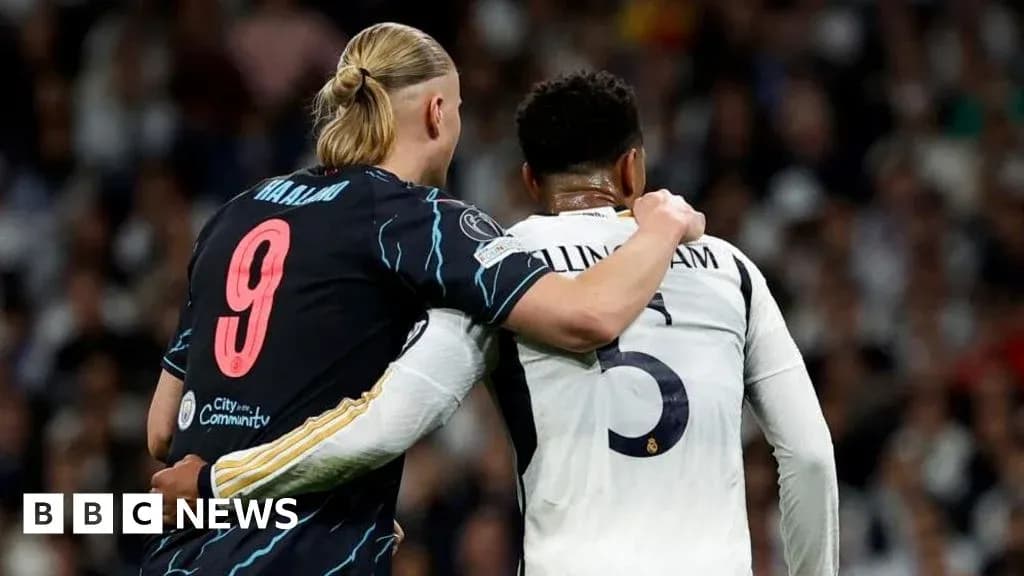
Bellingham and Haaland: The Unlikely Bromance in Football
At Borussia Dortmund, it started with a joke.
Two teenagers, Jude Bellingham and Erling Haaland, sitting side by side, reading out corny Valentine's Day pick‑up lines for a club video. BVB pushed it out on YouTube, probably expecting a few laughs and some harmless engagement.
They accidentally lit the fuse on one of modern football’s most unlikely double acts.
“I'd like to take you to the movies but they don't let you bring in your own snacks,” Haaland read, deadpan, turning to Bellingham with that familiar half‑grin. The clip did the rounds at the time. During this tournament, it has roared back into life, dragged out of the archives and repurposed as the internet’s favourite soft-focus side story.
What began as dressing-room chemistry has become something else: a small, warm counterweight to the noise and nastiness that so often define football online.
A different kind of superstar
PR expert Mark Borkowski has watched the sport’s relationship with image for decades. For him, the rise of the Bellingham–Haaland dynamic says as much about the era as it does about the individuals.
“If you go back to the days of the 90s or 00s a lot of brands fell out with footballers because they were so badly behaved,” he told the BBC. Back then, players and sponsors clashed regularly, scandals came thick and fast, and the commercial machine often winced at the behaviour of its own stars.
This generation looks different. Cleaner, sharper, more plugged into how they appear on screens that never switch off.
“If you look at this generation of footballers they are a different breed and I think it is a lot to do with social media,” Borkowski said. Haaland, he pointed out, comes from “a pretty wholesome family”. Both he and Bellingham have grown up in European dressing rooms, immersed in different cultures, exposed early to the scrutiny and expectations that come with elite club football.
That “European touch”, as Borkowski called it, has shaped them. Not just as athletes, but as recognisable, relatable personalities.
‘Cleated Rivalry’ and the internet’s favourite bromance
The internet has done the rest. Fans, never slow to spin a narrative, have leaned into the warmth between the pair with almost literary enthusiasm.
Some have invoked Heated Rivalry, a gay ice hockey romance novel, and jokingly cast Bellingham and Haaland as football’s own version. The fan-made title: “Cleated Rivalry”. Tongue firmly in cheek, but telling. Supporters see the personal charm, the tension of elite competition, the way they orbit each other in club and international storylines, and turn it into something bigger, softer, more playful.
Both players are reportedly in relationships with women, and there’s no suggestion their friendship is anything other than that. What matters here is how the public reads it: as a refreshing break from the endless churn of outrage and tribalism.
“In some ways it is a bit of an antidote in the sense that it gives people some relief from the more exhausting sides of football social media,” one observer told the BBC. Scroll any football feed and you’ll find the pattern: players turned into heroes or villains, every performance a referendum on their worth, every mistake a meme.
These clips of Bellingham and Haaland cut across that. “What these clips do is re-humanise two people who are normally cast as multi-million pound assets or rivals or goal-scoring machines,” the same observer said. On the pitch, they are “two of the most ruthlessly competitive players in world football”. Off it, the cameras catch something else: “funny, affectionate and clearly comfortable in showing they care about each other.”
That’s the twist. Two young men at the top of a hyper-masculine sport, refusing to act out the old script of forced hostility.
No need to fake the hate
In an age when rivalry is often exaggerated for clicks, Bellingham and Haaland offer something disarmingly simple. They want to beat each other. Badly. But they don’t feel the need to pretend they don’t like each other.
“There is also something incredibly refreshing about two young male athletes displaying a warm notionally open friendship without feeling the need to perform hostility for the cameras,” the observer said. They can “desperately still want to beat each other but still like and respect each other.”
It works because they are such different characters.
Bellingham is polished and articulate, media-trained but not mechanical, emotionally expressive in a way that connects with supporters. He talks about leadership, responsibility, the weight of the shirt, and it sounds natural.
Haaland, by contrast, leans into his own oddness. Eccentric. Deadpan. Instantly meme-able. He answers questions in short bursts, sometimes absurd, sometimes razor-sharp, always aware that every line can be clipped and shared within seconds.
“They are also a brilliant character pairing,” the observer noted. “Bellingham is polished, articulate, emotionally expressive, Haaland is much more eccentric, deadpan, naturally meme-able – I think together they reveal sides of each other fans don't normally see when they are performing as elite athletes.”
Together, they soften the edges. The superstar becomes the friend messing about in a training-ground video.
Family roots and quiet foundations
Away from the spotlight, the foundations of that ease look familiar: family, routine, normality where possible.
Haaland’s background has been well-documented, the “wholesome family” Borkowski referenced forming a key part of his public image. Bellingham’s private life remains more guarded. He is widely reported to be in a relationship with US model Ashlyn Castro, but he has chosen not to speak about it.
What he does talk about, often and with real weight, is his family.
“Looking back, I think if I had a dad that didn't play football, I probably would never have got into football really, because there was nothing there for me that motivated me to play at the start,” he told the England Football website. His father’s career and influence pulled him towards the game.
His mother, he says, did something different. She helped shape the person who steps onto the pitch.
“And then I have my mum who has taught me more about life outside football, but it merges quite well,” he explained. Lessons about staying calm, staying cool, being a good example, trying to lead – he traces those directly back to her. “I think a lot of that comes from my mum because she's a very good leader.”
It’s a striking contrast to the caricature of the modern footballer as insulated and self-absorbed. Bellingham’s words hint at a player who understands exactly where he came from and how that anchors him now.
Haaland, for his part, has let slip his own glimpses of domestic normality. “I cook dinner… It's going to be a little embarrassing for her that I say this, but she likes video games,” he said of his partner in one interview. It’s a small detail, but in the context of his larger-than-life on-field persona, it lands with unexpected charm.
The human story behind the highlight reels
Strip away the tactics boards, the transfer sagas, the endless debate shows, and football still runs on human connection. Between players. Between teams and fans. Between the version of a star you see on a billboard and the one who goes home and cooks, calls his mum, or sends a message to a friend he’ll face in a Champions League knockout tie.
That is why the Bellingham–Haaland friendship has caught fire again during this tournament. It doesn’t change who wins or loses. It doesn’t alter the numbers on the scoreboard. But it does something subtler: it reminds people that behind the goals and the glare are two young men navigating extraordinary lives, choosing to meet it all with a smile and a shared joke.
In a sport that so often demands conflict, they’ve shown there’s still room for warmth – even between rivals who might yet decide the biggest games of their generation.