.svg&w=384&q=75 "naujapitch logo")
World Cup 2026 Preview: The Absence of Italy and the Reign of Messi
The whole world is there. Italy watches from the touchline.
At 20:00, under the lights of the Azteca, a World Cup like no other kicks off: the first maxi American edition, 48 national teams, a month of football stretched across a continent and ending on 19 July. Mexico–South Africa opens the dance in one of the sport’s most mythic arenas, a stadium that still echoes with Pelé, Maradona and the ghosts of finals past.
This time, though, the story begins without the Azzurri. Italy stays home, reduced to a supporting role, present only through three men in suits on three different benches: Carlo Ancelotti, Fabio Cannavaro and Vincenzo Montella. Three Italian coaches scattered across a tournament that once revolved around the blue shirt.
Messi’s throne, and the challengers
Lionel Messi arrives as the king who refuses to abdicate. Argentina defend the trophy with the calm arrogance of a team that has already climbed the mountain and remembers every step.
“It will be tough to beat us,” Messi has warned. It is not a boast. It sounds like a statement of fact from a player who has seen every possible way to win and to lose a World Cup.
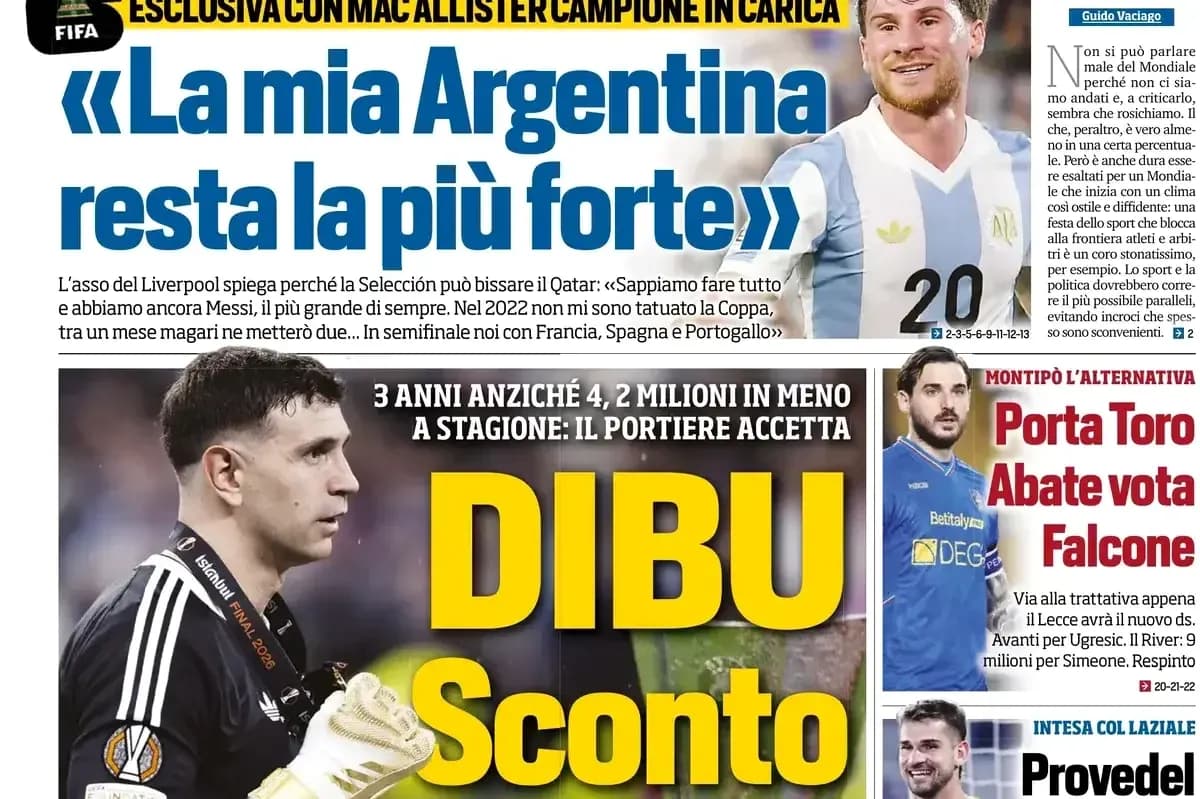
Alexis Mac Allister, one of the pillars of that triumph in Qatar and now a Liverpool mainstay, is equally convinced. In an exclusive interview, he lays out the blueprint for a repeat: the group, the mentality, the experience of having done it once already.
“My Argentina remains the strongest,” he insists. The logic is simple: the core is intact, the scars have healed into confidence, and Messi is still there, “the greatest of all time”. Mac Allister even jokes about his own unfinished business with destiny: he did not get a tattoo of the World Cup in 2022. This time, he says, he might get two.
He does not hide when asked about the final four. For him, the semi-finals are already sketched in pencil: Argentina, France, Spain and Portugal.
Spain, the algorithm’s favourite
If the bookmakers lean towards France and Argentina, the cold numbers point elsewhere. The algorithm says Spain.
Rodri, the metronome of La Roja and one of the most complete midfielders on the planet, embraces that pressure. “The level has been raised, my Spain side are favourites,” he declares. It is a bold line from a player who rarely wastes a word.
Spain arrive with a new generation that plays with the ball and with fire. At the heart of the excitement is Lamine Yamal, the prodigy who has turned from promise to problem for defenders in a matter of months. If Messi represents the enduring genius of an era, Yamal is the raw electricity of the next one.
France, so many stars, so many questions
And then there is France. A galaxy of talent, perhaps too bright, perhaps too dense. An attack to be feared, led by Kylian Mbappé, who chases his own slice of history after coming within a penalty shootout of back-to-back titles in Qatar.
The question around Didier Deschamps’ side is not quality but balance. How do you fit this many stars into a coherent system? How do you manage egos, expectations, the weight of being favourites every time you walk into a stadium?
France stand at the top with Argentina in the public imagination, but they know Spain lurk in the numbers and Portugal in the shadows, armed with experience and individual brilliance.
Italy’s World Cup, from the bench
On the pitch, Italy are absent. On the touchline, they are everywhere.
Carlo Ancelotti, “our Carletto”, carries Italian coaching know-how into the tournament once again, this time backed by a Champions League résumé that needs no introduction. Cannavaro, a World Cup-winning captain, and Montella, the former Azzurri striker, complete a curious trident: three different careers, three different ideas of football, one shared passport.
Italy’s flag will not rise before kick-off in any group match, but its school of coaching still shapes the tournament. In a World Cup dominated by high pressing, transitions and data, the Italian obsession with detail, structure and game management remains a quiet constant.
The last dance for two icons
This World Cup is not just an expanded edition. It is a farewell tour.
Edition number 23 is set to be the last for two icons of the modern game. Their names do not need to be shouted; their silhouettes are enough. One wears the Argentina shirt, the other leads France. Their careers have defined an era of international football, and both step into this tournament knowing there might not be another chance.
“The last dance,” as Corriere dello Sport frames it, is not just a slogan. It is the sense that a cycle is closing. Messi, already a world champion, plays with the freedom of a man who has completed his life’s mission. Mbappé, who has already lifted the trophy once, plays with the urgency of someone who wants to dominate an era, not just decorate it.
Three opening ceremonies, one question
The World Cup will have three opening ceremonies, a sign of its sprawling geography and its ambition to be everywhere at once. The first show comes tonight, before Mexico–South Africa at the Azteca. The rest of the world will join in over the coming days, each host city staging its own welcome.
Behind the fireworks and choreography lies a simple truth: from now until 19 July, everything in football bends around this tournament. Domestic leagues pause. Transfer rumours bubble in the background. Careers change in a single touch, a single mistake, a single moment of courage.
Forty-eight nations, one trophy, one long road through North America.
Argentina arrive with the crown. France with the firepower. Spain with the data and Rodri’s conviction. Portugal with the experience. Yamal with the future at his feet. Mbappé with a point to prove. Messi with nothing left to prove and still everything to win.
Italy, for once, will not walk out behind their flag. They will sit, watch, and influence from the bench, through Ancelotti, Cannavaro and Montella.
The whole world is there. The question now is simple: who dares to take it from Messi?