.svg&w=384&q=75 "naujapitch logo")
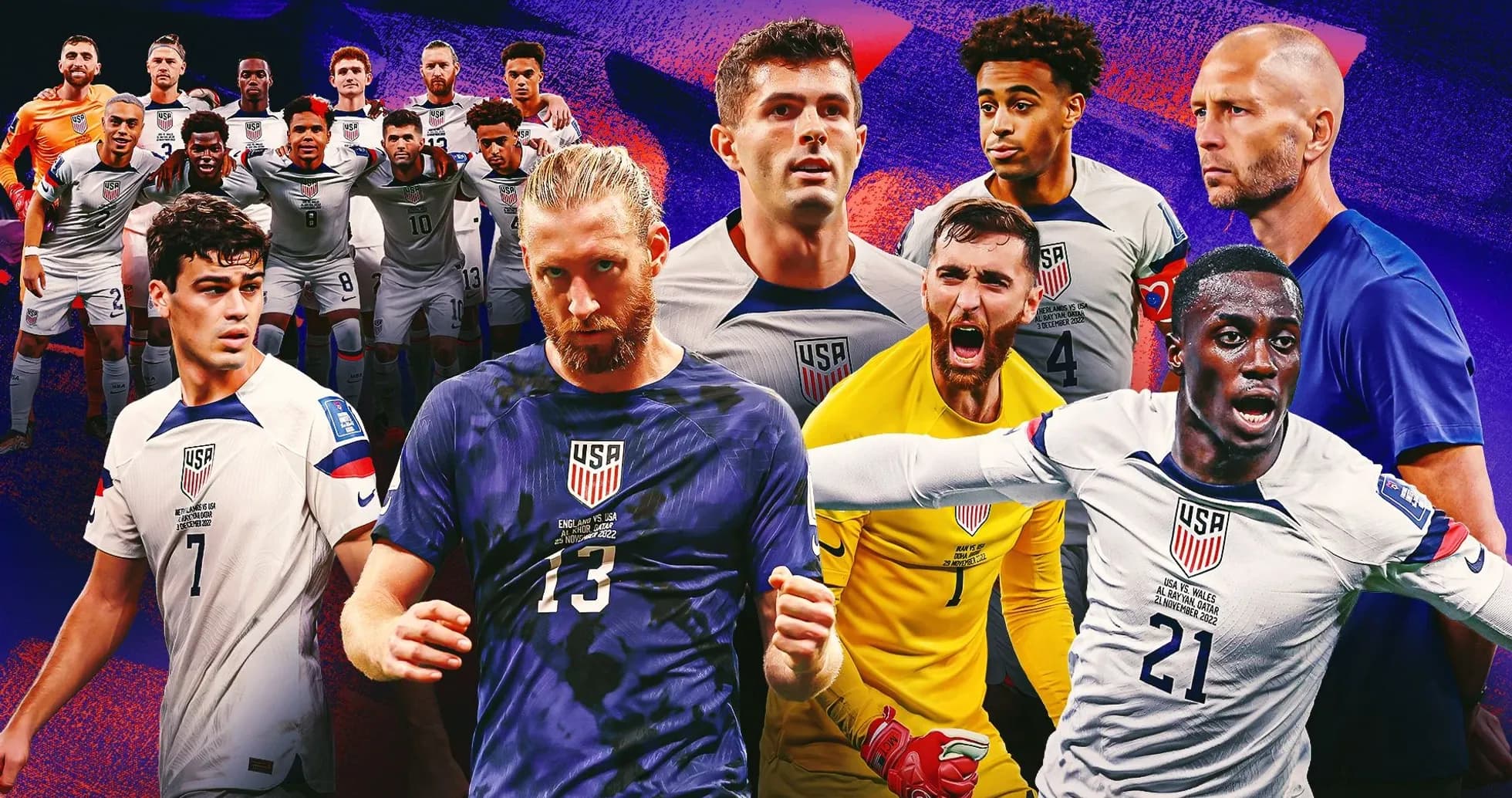
USMNT's Journey in Qatar: More Than Just a World Cup
On the eve of Wales, Gregg Berhalter did not talk tactics.
He talked history.
Inside the USMNT’s hotel in Qatar, he pulled all 26 players into a circle and handed them a number – their number. A place in a lineage.
“He said, ‘Each one of you guys has been assigned a number specific to you, and it represents what number you are representing the U.S. in a World Cup,’” Walker Zimmerman recalls. “For me, it was 152.”
One hundred and fifty-two. Not a shirt size. A census of dreams realized.
Zimmerman went back to his room. The jersey was waiting. The number hit him harder than any pre-game speech could.
“‘152, that’s it?’ That’s all that has ever gotten to this,” he says. “Then you go by position… you realize you’re in such an elite group of players who have ever gotten the chance to do it.”
For this group, that circle in the hotel wasn’t just about the past. It was about a shared journey that had started years earlier, on anonymous youth fields, long before the wreckage of 2018 forced U.S. Soccer to hand the keys to a new generation.
Tyler Adams, Christian Pulisic, Weston McKennie. They had grown up together in U.S. youth camps. Tim Weah, Josh Sargent, Sergiño Dest had their own set of teenage memories. By the time they reached Qatar, they were no longer just teammates. They were chapters in the same book.
“Those are the best memories,” Adams says. “My memories with Weston are always going to be more valuable as a kid. It’s the memories of us getting to that stage, even more than where we are now.”
Life in the bubble
Once the World Cup kicked off, the romance vanished under floodlights and fatigue.
No extended camp. No month-long build-up. Players flew in from Europe and MLS and were thrown straight into the furnace.
“It’s so quick,” Tim Ream says. “It was a little more condensed than a regular World Cup. You’re in such a bubble at the time.”
Kickoffs at 10 p.m. warped body clocks. Nights stretched to 3 a.m. Team staff asked players to stay up until 2 even on off-days, just to sync with the match schedule. Breakfast at noon. Lunch at four. Training in the dark.
Some tried to slow the blur.
“I have a good mental coach that I work with,” Sargent says. “It’s going to be a stressful time, you’re going to be nervous, but make sure that, while you’re there, take some deep breaths and be grateful and take it all in.”
Still, the days melted into each other. Three group games in eight days. Wales, England, Iran. Training, recovery, team meetings, late-night meals, hotel corridors that all looked the same.
“Looking back now,” Haji Wright says, “the World Cup was like a fever dream. It went by so fast.”
For others, the experience was quieter but no less powerful. Joe Scally never got on the field, one of five players not to feature, yet he felt the pull as strongly as anyone.
“A World Cup is a World Cup,” Scally says. “There’s nothing better in sports. Of course, it was different for me… but it also lit a fire underneath me.”
He watched the national anthem, the full stadium, the whole world watching, and wanted more.
“Of course, I was a part of it,” he says, “but not on the field.”
The goals that changed everything – and nothing
Heading into Qatar, only 22 American men had ever scored at a World Cup. Three more joined that club in 2022. Three goals, three very different stories.
Tim Weah went first.
Against Wales, with the U.S. back on the sport’s biggest stage for the first time since 2014, Pulisic threaded a pass through the back line. Weah glided onto it and slipped his finish into the net. For a generation raised on YouTube clips and European nights, it was the moment that said: we’re back.
“Leading up to that World Cup, I dreamt of scoring,” Weah says. “Years were passing by, and I literally always dreamt of that one moment at a World Cup… For it to become a reality, it was – man, it was amazing.”
Just playing in the tournament was a dream. Scoring made it something else entirely.
Then came Pulisic.
After a scoreless draw with England, the U.S. walked into a decisive third group game against Iran knowing only a win would do. The stakes were sporting and political, the tension thick. Pulisic cut through it with one brutal, self-sacrificing run.
As his shot rolled over the line, he crashed into goalkeeper Alireza Beiranvand and injured his pelvis. The ball went in. The player went down.
The iconic image that should have defined his World Cup – arms spread, face to the sky – never happened. Instead, there was a hospital visit, painkillers, and a FaceTime call back to the dressing room while his teammates finished the job.
“It would have been, and it was, a huge moment,” Pulisic told GOAL in 2024. “Normally… I would have had a pretty cool celebration with the team. You could see the team wanted to run over and celebrate, but it was like, I just didn’t have that.”
He shrugs at the irony now.
“Sometimes, things work out that way. I wouldn’t have changed it for the world… Unfortunately, I just had to celebrate that one lying in the goal.”
He insists he doesn’t chase an “iconic celebration.”
“I want to go in and I want to win these tournaments,” he says. “At the end of the day, people will talk about that and that’s what they’ll remember.”
Wright’s goal was different again. A flick, almost accidental, that looped into the far corner against the Netherlands in the Round of 16. It dragged the U.S. back into a game that had seemed lost. For a few minutes, the impossible felt possible.
“It felt crazy,” Wright says. “After it went in, I kind of felt like the momentum might change a little bit and felt we might get another opportunity.”
They never did. The U.S. went out 3-1. The goal became tangled in the pain of elimination.
“I don’t really have a memory of the moment of it because it was a happy and a sad moment,” he admits. “Being a World Cup goalscorer is amazing. Being knocked out of that same game, though? That’s what I remember.”
Only with time, and with the constant reminders of social media, have those three scorers begun to understand what their moments meant back home.
“We were just seeing the reactions online,” Weah says. “Seeing the fans back home when I scored or when Christian scored, it was amazing… just to see the impact that we have and the representation that we have in our country.”
The quiet moments that really stayed
The goals will live forever in highlight reels. Inside that squad, they are not necessarily the memories that matter most.
For DeAndre Yedlin, the only holdover from 2014, Qatar was about perspective. He had been the kid in Brazil. Eight years later, he was the veteran, leading younger teammates back out onto the pitch after every match, long after the cameras had turned away.
He wanted them to stand in the empty stadiums and simply look around. To feel it.
“It feels like adversity gets multiplied by 10 because there’s always a camera on you, always a microscope on you,” Yedlin told GOAL in 2024. “I think it’s important to find that space and peace.”
At its core, he says, football is entertainment. It can inspire, it can bring hope, but the players themselves are tiny figures in a vast picture.
“We’re so minuscule in the grand scheme of things,” he says. “We’re such tiny figures… but we also play a huge part.”
His teammates chased that balance in different ways. Some stayed off their phones. Some tried to memorize every detail. Others remember only flashes.
“I tried to stay off my phone as much as possible and just be in the moment with the guys,” Sargent says. “I feel like I can remember every single detail.”
Ream can’t.
“I can see glimpses of it,” he says. “I’m so insanely focused. It’s like tunnel vision. There’s a whole lot that you forget.”
What no one forgot was Qatar itself.
The call to prayer floating across Doha. The clash of old markets and brand-new stadiums. A city pulsing on World Cup time, every street corner pointing back toward the games.
“I enjoyed every bit of it,” goalkeeper Matt Turner says. “It was so cool to be in a culture I’ve never experienced before… It was special because we were in this foreign land all together… and we had just this rock solid bubble.”
Doha became a second skin. There was always another match on a screen, another bus of fans passing by, another flag in the wind.
Sergiño Dest tried to absorb as much as he could from the rooftop of the team hotel.
“I would just sit there, drink my water, and watch these people enjoy life,” he says. “They’d have flags and stuff, watching games, and I remember being like, ‘This is it.’”
He had a big room with a balcony. In the afternoons, he would open the window and just listen.
“You could… hear the sound of life,” he says. “That’s what I miss most about it.”
The Pearl, the lounge, the sanctuary
The team stayed at Marsa Malaz Kempinski on The Pearl, a man-made island that became their home. No flights between cities. No hotel changes. Just one base that turned into something more than a place to sleep.
For Yunus Musah, the connection was so strong he went back the following summer just to feel it again.
“Everything was like a throwback,” he said in 2025. “The smell! I could smell it again… I would just walk around, and it felt like I was experiencing all of those moments from the World Cup all over again.”
At the heart of it all sat the Players’ Lounge.
It was where they watched other World Cup games together, where they played pool and ping-pong, where video games ran late into the night. It was where they hid from the noise and pressure outside.
“We had so much downtime with one another that it really just allowed us to connect,” Adams says. “That Players’ Lounge… it was like our own little sanctuary.”
Berhalter made that space sacred. He knew this group’s bond was a competitive advantage.
“It just felt that, during the World Cup, I got even closer to some guys that I didn’t even know I could get closer with,” Adams says. “In those times, you just bond. That’s all there is to do.”
The competition never stopped. When they weren’t on the field, they were trying to beat each other at something.
“Sean Johnson and DeAndre Yedlin had their crazy style of pool that they were playing,” Zimmerman laughs. “It was basically snooker. They barely hit the ball and just tried to make you lose by scratching.”
Cristian Roldan barely saw his room.
“I remember being around the boys in the Players’ Lounge and making sure I didn’t spend any time in my room and didn’t take any moment for granted,” he says. “Whether it was training, hanging out in the lounge, or just watching my family enjoy it.”
The family section
Because a World Cup doesn’t just belong to the players. It belongs to the people who got them there.
Zimmerman felt that acutely before the opener against Wales. As the anthem played, his eyes went hunting for the family section: the cluster of parents, siblings, partners, children, friends who had spent years shuttling kids to training and sacrificing weekends, money, sleep.
“Everyone’s story is tied up with what that group of supporters has done to get us into this spot,” he says. “All of the sacrifices that those people made… That, for me, was a special moment.”
In the rare pockets of downtime when families were allowed into the hotel, players tried to freeze the images in their minds.
“For me, the only times that really do stick out, obviously aside from the games,” Ream says, “were the times where… the families could come over. Those were the only moments where you felt you could actually sit back and breathe and really think, ‘Okay, I’m going to take a mental picture of this and remember this.’”
Those gatherings did something else: they stitched the players’ families together, too.
“We were all really close already,” Weah says, “but having that period of time to connect and meet everyone’s family, share our lives together, that was amazing.”
Life has moved quickly since. Some players are fathers now. Others have seen their kids grow old enough to understand what “Dad’s job” really is. Marriages, moves, injuries, transfers – the usual churn of a footballer’s life.
For Roldan, fatherhood has sharpened everything.
“It was almost like it was a collective effort to get there,” he says of Qatar. “I think that’s where I got the most joy: getting to see my loved ones there and enjoying it.”
Now, his daughter is nearly two.
“Part of my motivation to extend my career and continue to play at a high level is that I want her to watch me play,” he says. “I want her to watch daddy play… rather than just being a bench player.”
Sebastian Berhalter experienced it all from the stands, watching his father coach the USMNT on the sport’s biggest stage.
“It’s the one time I got to feel like an ultra,” he says. “Seeing your dad coach against some of the best teams in the world was something I’ll never forget.”
The scars of those who missed out
Not every story from 2022 carries a warm glow.
For Gio Reyna, Qatar became a flashpoint. He arrived battling injuries. His role shrank. Emotions boiled over. Questions about his attitude in training leaked out. After the tournament, the Reyna family informed U.S. Soccer of a decades-old domestic violence incident involving Berhalter. The fallout dominated headlines and eventually shadowed the entire program.
It was messy. It was personal. It went far beyond minutes on a pitch.
Berhalter returned in 2023, then departed after a Copa América exit in 2024. Mauricio Pochettino took over. Reyna stayed in the player pool, his talent unquestioned, his World Cup experience complicated.
“I think just individually and collectively, we were all very, very young and maybe a little bit inexperienced at the time,” Reyna says now. The Netherlands, he notes, were “a little bit more experienced, a little bit better, a little bit more savvy.”
He calls the World Cup “an amazing experience” but also a harsh teacher.
“You learn that it’s about just trying to do whatever you can to help the team,” he says. “This is your whole country that’s fighting something… It’s about the collective.”
Reyna is not alone in carrying unfinished business.
Miles Robinson should have been there. He was a cornerstone of qualifying, almost a lock to start in Qatar. Then his Achilles snapped in May 2022. The World Cup was gone in an instant.
When the tournament finally kicked off, he had a choice: look away or lean in.
“Man, I was outside watching that sh*t,” he told GOAL with a smile. “We were partying, watching, cheering on my guys. I really wanted to experience that real-life energy because that’s who I am.”
Chris Richards never got that far emotionally. A hamstring injury with Crystal Palace ended his World Cup hopes weeks before the squad announcement. He stayed in London, rehabbing, watching his friends play on television.
“I was so, so happy for them,” he says. “But for myself, it was lonely… I didn’t want anything to do with soccer.”
Mark McKenzie’s exclusion came not from injury, but from the manager’s list. That cut deeper.
“Missing out on the 22 World Cup? It ripped me apart, bro,” he says. “When you get that call that you’re not going, that you weren’t selected, it’s a punch to the stomach.”
Only later did he see what it taught him.
“Maybe I put too much onus on this,” he says. “So much that I lost who I was, lost focus on the small areas of my game or my life that I need to improve.”
From prelude to main event
The ripples from Qatar didn’t stop when the plane landed.
For Adams, the change hit him on the streets of New York.
“From a notoriety standpoint, people all of a sudden knew who I was walking back home,” he says. “It’s a city that I never imagined I’d get recognized in.”
He was juggling that new visibility with another life shift: his first child on the way. Public and private pressures collided.
Now the entire squad faces a different kind of weight.
The 2022 World Cup, in many ways, was a dress rehearsal. The real show arrives in 2026, on home soil, with Pochettino in charge and a sport still growing in a country that will expect more than a plucky Round of 16 exit.
“It’s an amazing feeling, but also a responsibility at the same time,” McKennie says. He knows this generation has become the faces on the screens kids now study, the players whose paths will be traced and twisted into dreams.
“Hopefully, people see that there is a pathway out there for them,” he says. “It may not look exactly like mine or Christian’s or Chris Richards’, but the ultimate thing is to believe in yourself and bet on yourself always.”
Soon, 26 more players will live their own fever dream. Some will arrive armed with Qatar’s lessons. Others will be wide-eyed rookies. Some will start every game. Some will never leave the bench. All of them will leave changed.
For the class of 2022, that winter in Qatar will always be a bond and a benchmark. For some, it was the pinnacle. For others, a beginning. For a few, a wound that still hasn’t fully healed.
“I can understand how people call it emotionally draining,” Wright says. “After it was over, it felt like soccer had changed me, in a way, and now you find yourself chasing that same feeling. It’s hard to get that feeling again outside of a World Cup.”
Turner feels it too.
“I had some amazing experiences,” he says. “That’s why I need to get back there, because I really want that feeling again.”
The next chance is coming. The question now is simple, and ruthless: what will this generation do with it, when the World Cup no longer feels like a dream, but an obligation?