.svg&w=384&q=75 "naujapitch logo")
Middlesbrough's Promotion Hopes Dashed by Southampton Spygate Scandal
Kim Hellberg stood in the bowels of St Mary’s, nursing a 2-1 extra-time defeat that ended Middlesbrough’s promotion dream. Yet the wound that hurt most had nothing to do with Southampton’s winning goal.
“It breaks my heart,” the Swede said. He was not talking about missed chances or defensive lapses. He was talking about Spygate.
A semi-final poisoned
In any normal year, the conversation would have flipped instantly to Wembley and the Championship play-off final on 23 May. Instead, English football is staring at a legal and moral minefield.
Southampton, charged by the EFL with spying on one of Boro’s final training sessions before the first leg at the Riverside, stand one game from the Premier League. They also stand accused of crossing a line the league explicitly drew in the aftermath of Marcelo Bielsa’s infamous Leeds-era surveillance.
Hellberg’s anger is not abstract. Middlesbrough staff intercepted an individual at their Rockliffe Park base, a man they believe had driven five hours on Southampton’s behalf to film a session in the 72-hour lockdown period before a game.
“If we hadn't caught that man that they sent up five hours to drive, you would sit there and say well done [to Southampton] in the tactical aspect of the game and I would go home and feel like I've failed,” Hellberg said. “When that is taken away from you… it breaks my heart in terms of all the things I believe in.”
Southampton have not tried to deny the allegations. They are charged with breaching both the broad “utmost good faith” regulation E.4 and the specific anti-spying regulation 127. The case now leaves the pitch and walks into a hearing room.
Wembley on hold
The play-off final is 10 days away. Tickets should be flying out, travel plans locked in, banners painted. Instead, the showpiece occasion hangs in the hands of an independent disciplinary commission run by Sport Resolutions.
The EFL has asked for an expedited hearing. Southampton have asked for more time to complete an internal review. Time is exactly what nobody has.
Wembley is unavailable the following weekend. International duty follows. There is no realistic window to push the game back. One way or another, this must be settled well before 23 May.
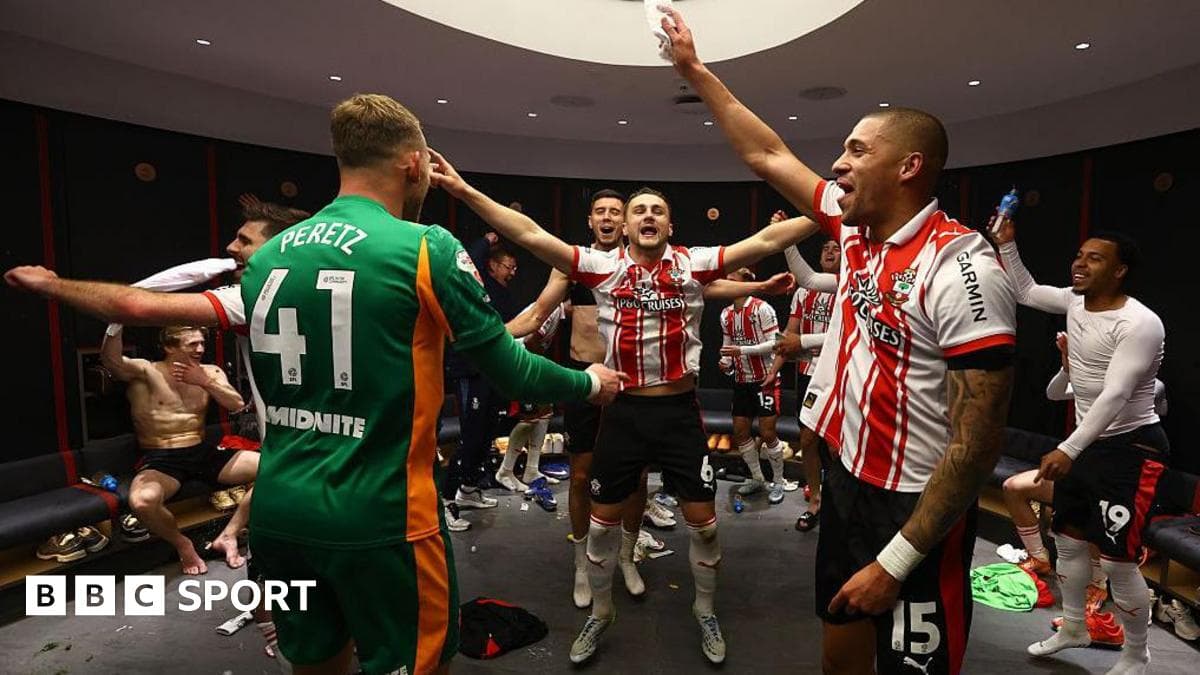
Southampton are trying to behave as if nothing has changed. The players celebrated on Tuesday night, though not with the abandon usually reserved for reaching a final. On Wednesday morning, the club quietly launched a play-off final merchandise range on their website. No fanfare, no big push on social media. On Thursday, tickets go on sale for a match their supporters might never attend.
Head coach Tonda Eckert at least has clarity of a kind: he prepares for Hull City at Wembley until told otherwise. For Hellberg and Boro, there is only limbo.
BBC Sport understands Boro’s players will be given a few days off rather than continuing with full-intensity training. They must stay on standby. No Dubai, no Ibiza, no early escape to summer. If the commission throws Southampton out, Middlesbrough expect to be walking out under the arch.
For them, there is only one acceptable outcome: they play in the final.
Gibson loads the legal guns
Inside the Riverside boardroom, sentiment has hardened. A fine, Middlesbrough insist, will not do. They want a sporting sanction.
Owner Steve Gibson has reportedly turned to Nick De Marco, the heavyweight sports lawyer whose name has become a familiar one in cases involving English football’s governing bodies. De Marco helped ensure Sheffield Wednesday avoided a 15-point deduction and started this season on zero. This time, he would be arguing for punishment, not leniency.
Gibson has been here before. In 2021, Boro launched legal proceedings against Derby County, claiming the Rams’ financial breaches had cost them a play-off place in 2018-19. The case ended in a “resolution” understood to be worth around £2m to Middlesbrough.
If Southampton keep their place in the play-offs and go on to win promotion, nobody would be surprised to see Gibson pursue similar compensation. But that would be a back-up route. The priority is simple: throw Southampton out now.
The mechanism is obvious. Boro want a default 3-0 win awarded for the first leg, which would flip the tie to a 4-2 aggregate victory and send them to Wembley. It would be a seismic decision, but English football has seen technical victories before. In 2002, West Brom were awarded a 3-0 win over Sheffield United after the Blades dropped below seven players when three were sent off and two more went off injured.
Another option is a points deduction, either applied to this season’s play-off standings or carried into next season. That would be the halfway house: a sporting sanction without detonating the nuclear option of expulsion. If Southampton go up, the EFL cannot impose the penalty in the Premier League itself, but it can recommend that the top flight carries it over.
The commission must find something that feels fair and still screams deterrent.
A new frontier in punishment
This is where the case becomes truly awkward. There is no neat precedent.
Leeds were fined £200,000 in 2019 after Bielsa admitted sending staff to watch Derby train. But at that time there was no specific rule banning the practice. Leeds were done under the catch-all “utmost good faith” regulation. The EFL then wrote regulation 127 to close the loophole.
Southampton are the first major test of that rule. They stand accused of spying not in mid-season, but on the eve of a play-off semi-final, one of the most lucrative and pressurised fixtures in the calendar.
The independent disciplinary commission, a three-person panel chaired by a senior legal figure, will in effect write the template for every future case. There is no sliding scale, no tariff, no ready-made table of offences and punishments. They are drawing the line in real time.
The process itself is opaque. The commission sets its own timetable, which is not made public. The EFL can push for speed, but cannot dictate it. All parties deemed to have an interest – and that could include Middlesbrough – must have the right to appeal. Any appeal decision is final. EFL rules block any further move to the Court of Arbitration for Sport.
Behind those legal phrases lies a basic reality: an entire season, and possibly the financial futures of both clubs, is about to be shaped by people who have never kicked a ball at this level.
Silence from Saints, fury from Teesside
Southampton have gone quiet. Their media officer has shut down attempts to question Eckert about the case. The club has offered no public defence, no explanation, no narrative of its own.
Inside that silence, serious questions wait.
Who knew what, and when? Was there a live stream of Boro’s session? Was any footage shared, uploaded, analysed? Or will Southampton argue that the man at Rockliffe Park was a rogue operator, a lone wolf who took it upon himself to travel north 24 hours before the squad flew up?
Hellberg does not buy that. “There's someone who makes decisions to go and try to cheat,” he said on Tuesday night. For him, this is not a misunderstanding or a grey area. It is a betrayal of the basic trust between clubs.
There is a global precedent at the more extreme end of the scale. At the 2024 Olympics women’s football tournament in Paris, Fifa deducted six points from Canada after they were found to have spied on New Zealand using a drone. Three members of Canada’s staff, including the head coach, received year-long bans from all football.
Could the Southampton case end with bans for members of Eckert’s staff? The framework allows for it. The question is whether the commission believes this was systematic enough to warrant personal as well as club punishment.
Fans caught in the crossfire
Amid the legal manoeuvres and ethical arguments, thousands of supporters are left dangling. Southampton fans have followed their team through 48 games to reach this point. On pure sporting merit, they have earned the right to play for a place in the Premier League.
Do they deserve to see that snatched away?
That is the most uncomfortable question of all. Strip away the romance and the emotion, and the sport has to decide what it wants to be. Without meaningful sporting sanctions, the risk is obvious: clubs gamble, send spies, push boundaries, and shrug off fines as the cost of doing business.
If Southampton win promotion and any punishment amounts to a financial slap on the wrist, what message does that send? Where is the deterrent if the prize is Premier League money and the price is a line item in the accounts?
The EFL wants clarity. Middlesbrough want justice. Southampton want time. The commission wants to get it right.
Somewhere between those competing demands lies a verdict that will echo far beyond one tense night at St Mary’s.