.svg&w=384&q=75 "naujapitch logo")
Mexico's Tactical Mastery in 2-0 Win Over South Africa
Mexico’s 2-0 win over South Africa at Estadio Azteca was built on structural control, numerical superiority in midfield, and a clear plan to manipulate South Africa’s back five. Javier Aguirre’s 4-1-4-1 outpassed and out-possessed Hugo Broos’s 5-3-2, translating 61% of the ball and a 16–3 shot advantage into a comfortable territorial grip that the raw scoreline arguably understates.
Mexico’s shape was the platform. Erik Lira operated as the single pivot in front of a back four, with Brian Gutiérrez and Álvaro Fidalgo as twin advanced interiors and Julián Quiñones plus Roberto Alvarado tucking in from the flanks. This created a 3v3 or 4v3 overload against South Africa’s midfield trio of Teboho Mokoena, Siphephelo Sithole, and Jayden Adams, who were continually dragged into wide and vertical dilemmas.
The opening goal on 9 minutes encapsulated the design: Lira stepped into the right half-space, receiving between South Africa’s first and second lines, and found Quiñones attacking the channel from his nominal left-midfield berth. The pass split a narrow back five that struggled to pass runners on; Quiñones’ finish rewarded Mexico’s insistence on playing through the inside lanes rather than relying on crosses.
Out of possession, Mexico’s 4-1-4-1 morphed into a compact 4-5-1 mid-block, with Gutiérrez and Fidalgo dropping alongside Lira. The front five pressed selectively, choosing triggers when the ball went to the outside centre-backs or wing-backs. South Africa, with only 335 passes to Mexico’s 520, rarely progressed cleanly; their 3 total shots and xG of 0.07 underline how effectively Mexico kept them away from central zones and from the box (only 1 shot inside the area).
The game’s tactical axis tilted further on 49 minutes when Sithole’s “Professional foul last man” red card left South Africa down to ten. Already pinned deep in a 5-3-2, they now had to sacrifice attacking ambition almost entirely, sinking into a 5-3-1 and then, after later changes, a makeshift 5-2-2. Mexico responded by increasing the tempo of circulation rather than simply adding crosses. Lira’s withdrawal for Edson Álvarez at 76 minutes did not change the structure; it refreshed the pivot role to maintain control against a tiring, undermanned opponent.
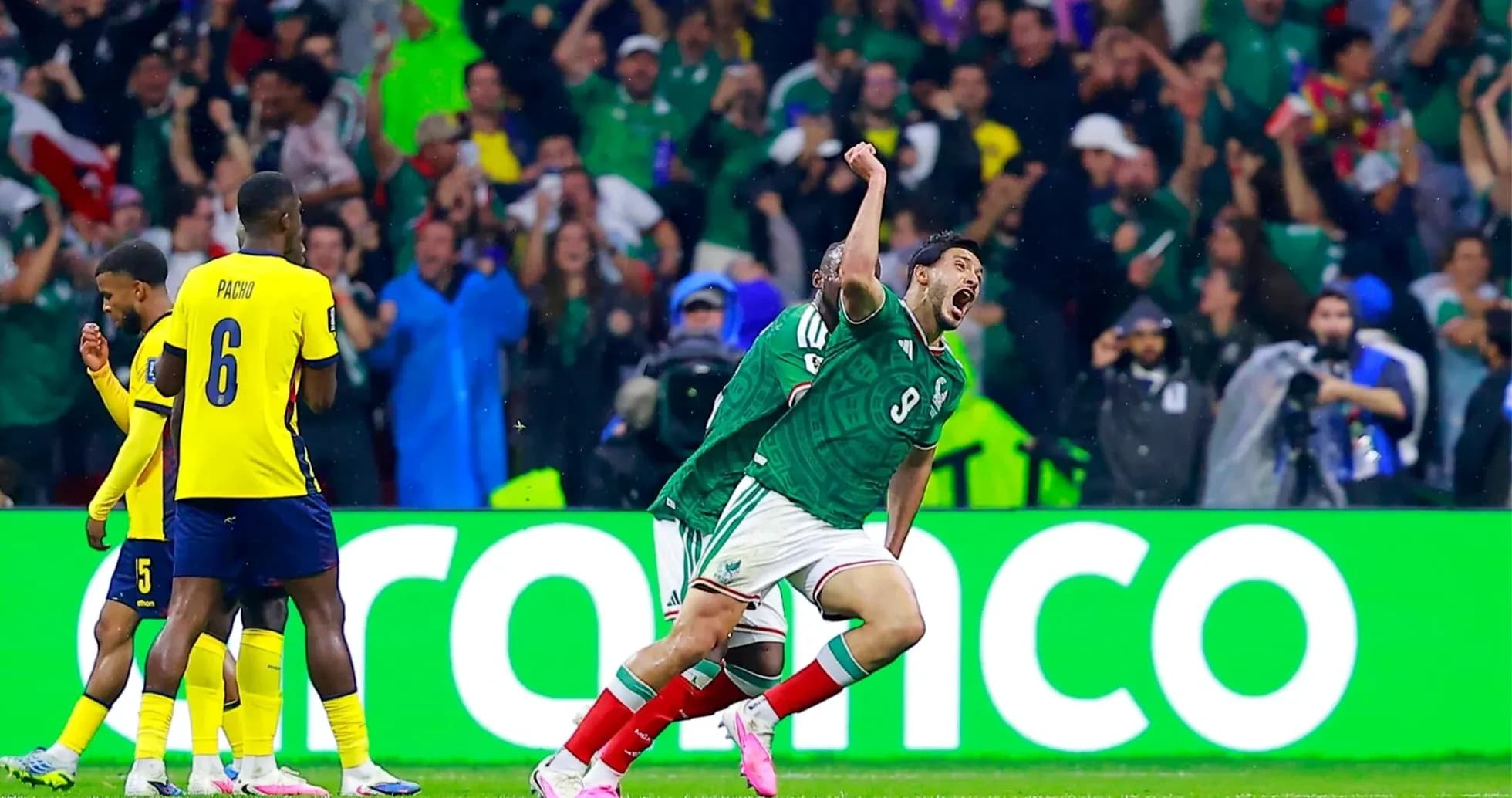
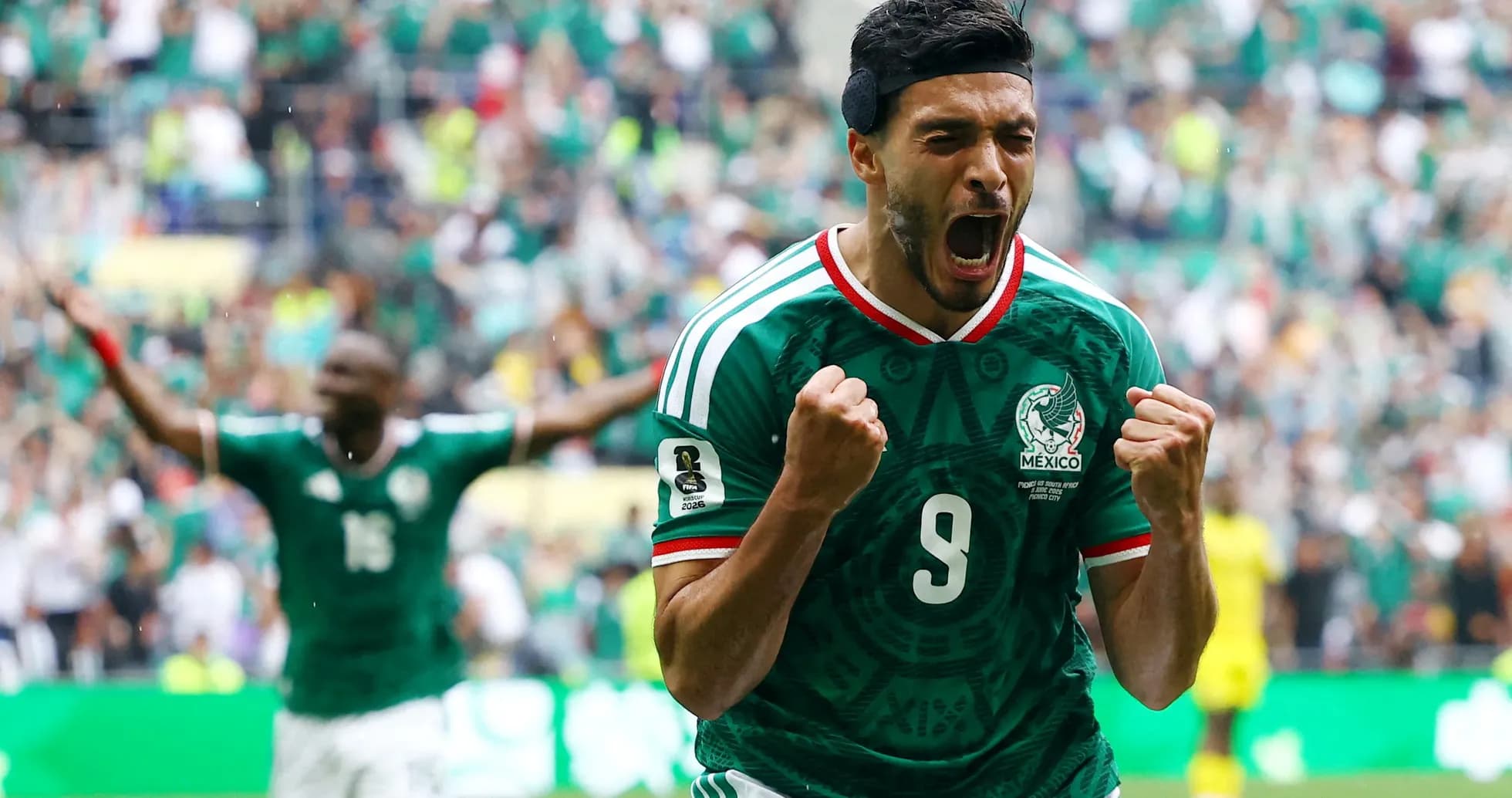
The second goal at 67 minutes was the natural consequence of that pressure. Alvarado, operating from the right, combined in the half-space and delivered for Raúl Jiménez, whose movement between centre-backs punished South Africa’s increasingly reactive line. It was a textbook exploitation of a back five forced to defend its box for long periods: once the midfield screen was weakened by the red card, Mexico’s second-line runners and centre-forward could arrive into gaps rather than receive with backs to goal.
In terms of personnel, Raúl Rangel (Mexico) was largely untroubled, facing only 2 shots on target and making 2 saves. His primary contribution was in build-up: with Mexico attempting 520 passes at 90% accuracy (467 accurate), Rangel’s calm recycling allowed the centre-backs César Montes and Johan Vásquez to stay wide and stretch South Africa’s first line. On the opposite side, Ronwen Williams (South Africa) made 2 saves from Mexico’s 4 shots on target. The fact that Mexico generated 16 shots but “only” 1.41 xG suggests a lot of their efforts were from controlled but not always prime locations, a reflection of South Africa’s low block at least partially protecting the central six-yard corridor even while ceding territory.
Broos’s initial 5-3-2 was clearly designed to congest central zones and break through the front pair of Lyle Foster and Iqraam Rayners. However, with just 39% possession and 81% pass accuracy (272 accurate from 335), South Africa rarely connected enough passes to transition into meaningful attacks. Their wing-backs, Aubrey Modiba and Khuliso Mudau, were pinned back by Mexico’s wide players and full-backs, preventing the system from ever becoming the intended 3-5-2 in attack.
After going down to ten, South Africa’s substitutions were about damage limitation and fresh legs rather than a structural rethink. Thalente Mbatha for Foster at 56 minutes and Themba Zwane for Adams at 61 minutes sought to reinforce midfield presence and ball retention, but the subsequent VAR-initiated “Card upgrade” and red card for Zwane on 84 minutes for “Violent conduct” reduced them to nine and removed any possibility of a late push. With Nkosinathi Sibisi also booked on 74 minutes for “Foul”, South Africa’s back line spent the closing phase defending deep and on disciplinary thin ice.
Mexico, for their part, managed the game with a mix of control and rotation. Gilberto Mora (IN) came on for Fidalgo (OUT) and Luis Chávez (IN) for Gutiérrez (OUT) at 66 minutes, adding fresh energy in the interior channels. Armando González (IN) replaced Jiménez (OUT) at 76 minutes to press from the front and run the channels, while Edson Álvarez (IN) for Lira (OUT) at the same time ensured the pivot role remained secure. Alexis Vega (IN) for Quiñones (OUT) at 79 minutes gave Aguirre a left-sided outlet to stretch a nine-man opponent. The only blemish for Mexico was César Montes’ 90+2 minute red card for “Professional foul last man”, which will have consequences for rotation later in the group but did not alter the tactical storyline of this match.
Statistically, the verdict aligns with the eye test. Mexico’s 61% possession, 16–3 shot count, 9 efforts inside the box, and xG of 1.41 against South Africa’s 0.07 paint a picture of near-total control. Both teams recorded 2 saves each, but that symmetry is deceptive: Mexico’s defensive structure limited South Africa to speculative efforts, while South Africa’s low block and Williams’ positioning kept the scoreline from becoming heavier.
Discipline was a decisive differentiator. Mexico took 12 fouls and 1 yellow card (Gutiérrez for “Foul”) plus Montes’ late red, but South Africa’s 11 fouls translated into 2 yellows and 2 reds: Mokoena’s and Sibisi’s bookings for “Foul”, Sithole’s dismissal for “Professional foul last man”, and Zwane’s for “Violent conduct” after a VAR “Card upgrade” process. Those dismissals turned a difficult defensive assignment into an almost impossible one, and Mexico’s patient, possession-based approach was ruthless enough to convert that advantage into a controlled, tactically coherent 2-0 victory.