.svg&w=384&q=75 "naujapitch logo")
Martin O'Neill Confirmed as Celtic's Permanent Manager
Martin O’Neill is set to be confirmed as Celtic’s permanent manager once again, after the 74-year-old agreed a one-year deal to stay in Glasgow – with an option to stretch the reunion into a second season.
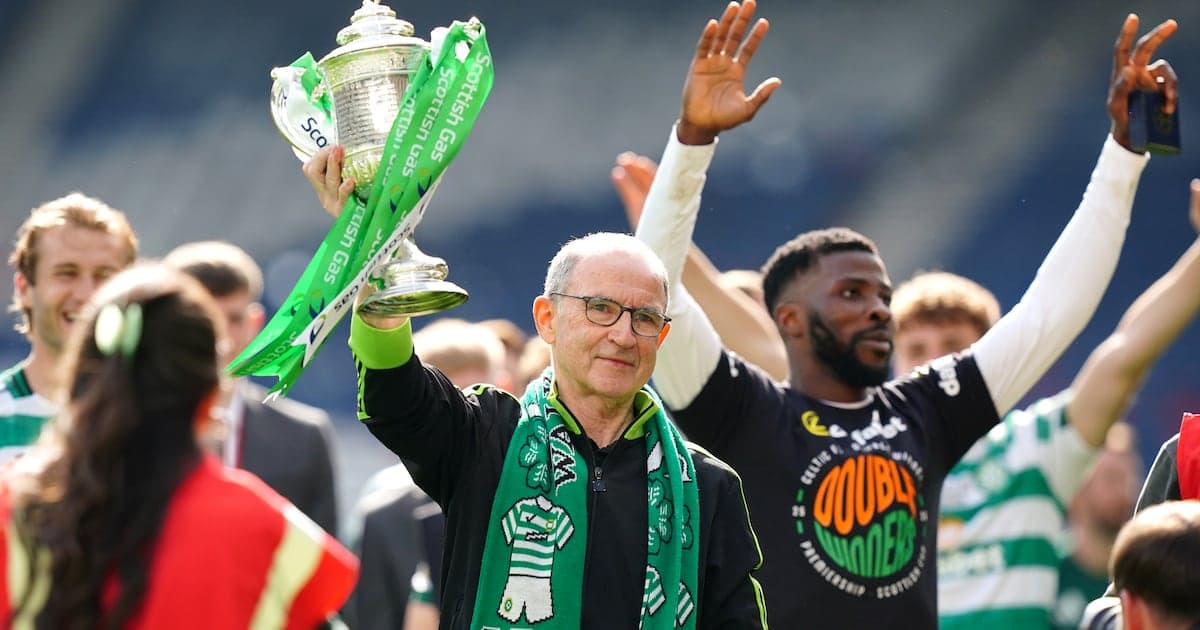
The contract is the formal reward for a remarkable return. Dragged back into the technical area on an interim basis not once but twice this season, O’Neill still found time to deliver a domestic double, including the Scottish Cup final win over Dunfermline that closed the campaign with a familiar shade of green-and-white dominance.
He walked away from Hampden that day asking for time to think. The truth? It never felt like a farewell. Those close to the situation sensed from the start that the Northern Irishman, whose relationship with Celtic borders on the mythic, wanted the job beyond the stop-gap role he had been asked to fill.
The club, though, did briefly look elsewhere.
Robbie Keane emerged as a serious contender and even sat down with Dermot Desmond, Celtic’s principal shareholder, earlier in the week. Keane’s candidacy made some sense on paper: a high-profile name, coaching experience in Israel with Maccabi Tel Aviv and in Hungary with Ferencvaros, where he resigned at the end of May.
But football decisions are rarely made on paper alone at a club like Celtic. A vocal section of the support reacted furiously to the idea of Keane in the dugout, angered in particular by his spell in Israel. The backlash was loud, organised and impossible for the board to ignore. Whatever momentum Keane had quickly drained away.
The path cleared for O’Neill. Again.
His impending appointment arrives with a striking symmetry. It is 26 years since Desmond first persuaded O’Neill to swap Leicester for Glasgow, a move that changed the modern history of the club. That first era delivered three Scottish titles, three Scottish Cups and two Scottish League Cups, and carried Celtic all the way to the 2003 Uefa Cup final, where José Mourinho’s Porto finally stopped them in Seville.
Those years established O’Neill as one of the defining Celtic managers of the post-war period. The second act, in contrast, began in chaos.
Brendan Rodgers’ resignation last October left Celtic scrambling. O’Neill answered the call, steadying the side until Wilfried Nancy was appointed. The Frenchman’s tenure collapsed almost as soon as it began, lasting only eight games and leaving the season listing badly.
Celtic turned once more to the old master. O’Neill came back, tightened the structure, restored belief and, crucially, kept the Premiership trophy in the east end of Glasgow. The double that followed turned an emergency measure into an irresistible argument for continuity.
Now the interim tag is about to disappear. The one-year deal, with its option for a second, gives Celtic breathing space and gives O’Neill the authority of permanence without locking either party into a long-term gamble.
For the supporters who grew up on his first great side and for a squad that has already responded to his voice, the message is clear: the past is not being replayed, but the man who helped write it is in charge again.
At 74, O’Neill returns not as a nostalgic figurehead but as the manager trusted to shape Celtic’s immediate future. The question now is not whether he deserves this chance. It is how far he can push this team, one more time.